

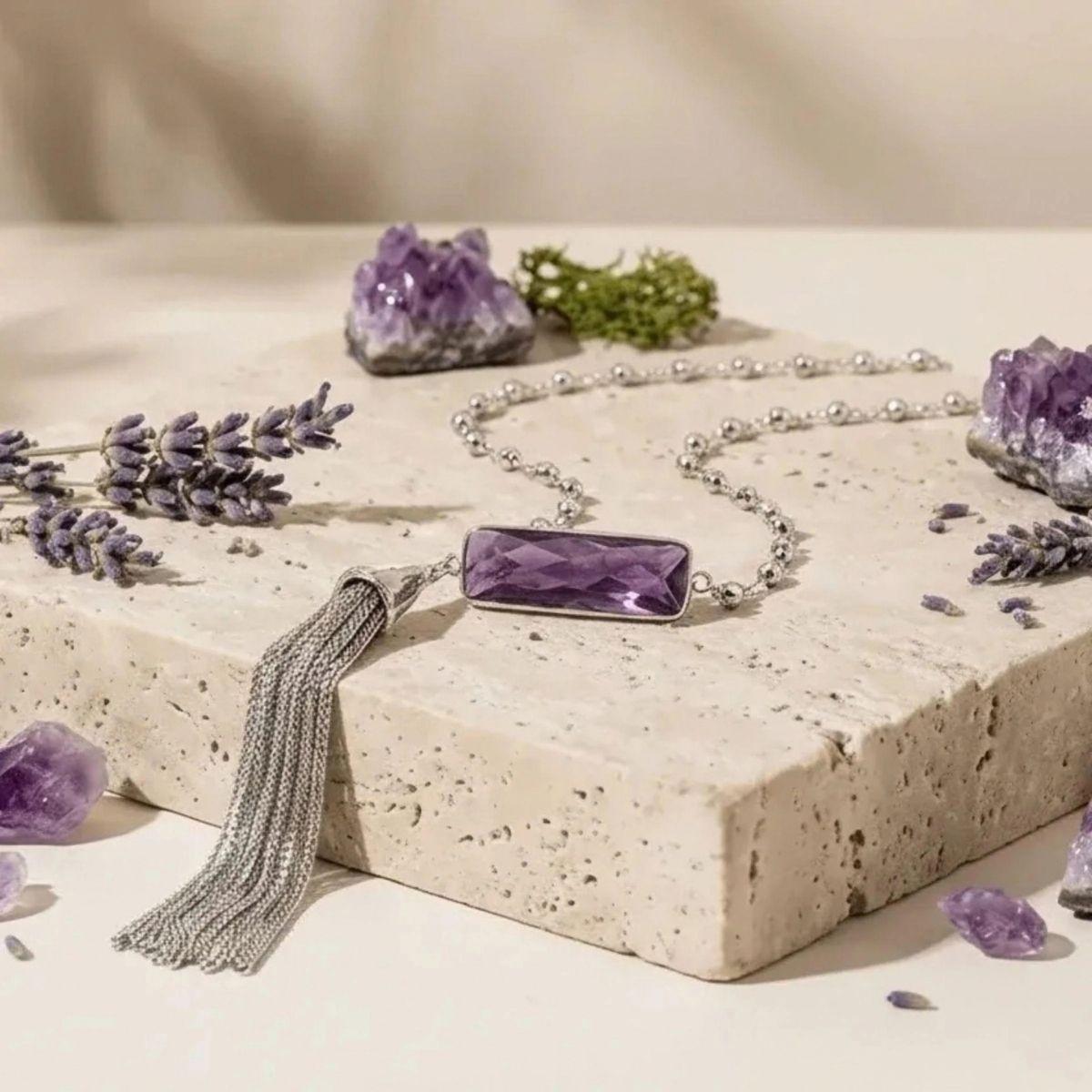
February's birthstone is amethyst — purple quartz, worn for centuries, and one of the easier gemstones to buy well if you know what you're looking at.
This guide is for choosing and wearing. What separates a good amethyst from a mediocre one, what natural and lab-grown and glass mean, what to ask before you hand over money, how to wear it, and which pieces are worth it.
If you're here for what amethyst means, that's a different guide — What amethyst means covers the shades, the pairings and the chakras.
Ready to wear it? My February birthstone necklaces and earrings all sit on one shelf: genuine and treated stones first, labelled look-alikes after, so you always know what you're getting.
Quick Shop: Shop February | All Twelve Birthstones | Shop Every Month | Amethyst Jewelry

Jump To: The February Birthstone | History | How to Judge Quality | Natural vs Lab vs Glass | Buying Checklist | What to Buy | How to Wear It | Gift Ideas | Care | FAQ
What Is the February Birthstone?
Amethyst — a purple variety of quartz, and February's birthstone on both the modern and traditional lists.
Three things make it a good buy. It ranges from pale lilac to deep violet, so there's a version for almost anyone. It rates 7 on the Mohs hardness scale, which is durable enough for real daily wear. And it looks genuinely good in both silver and gold, which not every stone does.
Because February runs into Pisces season (February 19 – March 20), amethyst doubles as a zodiac stone for late-February birthdays — useful if you're buying a gift and want it to land on two levels.
The short version of what it means: calm, clarity, intuition, quiet protection. The amethyst meaning guide goes properly into it, including which shade suits which person.
Shopping for a different month? The complete birthstone guide covers all twelve — including why several months have more than one stone.
A Quick History — and Why It Was Once Priceless
The name comes from the ancient Greek améthystos, meaning "not intoxicated." The Greeks believed the stone kept you clear-headed, and drinking vessels were sometimes carved from it on that logic.
Purple has meant royalty across most of recorded history, largely because purple dye was extraordinarily expensive to produce. Amethyst rode that association — it appears in Egyptian, Roman and medieval European regalia, in cathedral rings, in crown jewels.
Here's the part most guides skip: amethyst used to be as valuable as ruby and emerald. That changed in the 1800s when enormous deposits were found in Brazil, and the price collapsed almost overnight. Nothing about the stone changed. Only the supply did.
Which is a useful thing to know when you're shopping. You're buying a stone that was once reserved for royalty, at a price that reflects geology rather than beauty.
How to Judge Amethyst Quality — Five Things
1. Colour
The single biggest driver of value. Amethyst runs from pale lilac to deep violet, and the most prized stones show rich, even, saturated purple — sometimes with red or blue flashes.
But "most valuable" and "best for you" are different questions. A deep violet you find intimidating stays in a drawer. Buy the shade you'll reach for.
2. Clarity
Good amethyst looks bright, not cloudy. Hold it at arm's length — you shouldn't see obvious inclusions from normal viewing distance. Faceted amethyst in particular should be clean; it's abundant enough that you don't need to accept a murky stone.
3. Cut
A well-cut amethyst is lit from within. Look for crisp facet edges, an even polish, and light bouncing back at you rather than leaking out the bottom. A poor cut makes a good stone look dull.
4. Setting
Necklaces are the easiest to live with — they take the least abuse. Earrings give the most visual return for the money. Rings need a secure setting, because at hardness 7 amethyst will chip if you knock it hard enough.
5. Metal
Silver keeps amethyst cool and modern. Gold warms it and leans regal. Match it to what the wearer already owns — the piece that gets worn is the one that goes with everything else in the jewelry box.


The same double teardrop in silver and gold. Shop the double teardrop necklace — $65 →
Natural, Lab-Created & Glass — What You're Buying
None of these are bad. What matters is that you know which one you're holding, and that the price matches.
Natural amethyst
Formed in the earth over a very long time. May show colour zoning — bands of lighter and darker purple within one stone — and small inclusions. Many people prefer it precisely for that: no two are identical, and the imperfections are the evidence it's real.

Natural amethyst up close — the zoning and inclusions are the tell.
Lab-created amethyst
Chemically identical to natural. Same mineral, same hardness, same colour mechanism — grown in controlled conditions rather than in the ground. Lab-grown stones are typically cleaner and more consistent in colour, at a lower price.
This is not a lesser stone. It's the same stone with a shorter and better-documented supply chain. The lab-grown gemstones guide explains how it's done.
Glass
Glass is a different material, and honest sellers say so. It's chosen for vivid colour, light weight and price — which makes it genuinely good for statement earrings, where a heavy natural stone would drag on the earlobe all day.
The Marquise Earrings — $35 and the Ombre Purple Necklace — $35 are both glass, and both are labelled that way on the product page. Bought knowingly, glass is a perfectly good choice. Bought thinking it's gemstone, it isn't.
"Treated" isn't a dirty word
Treatment means enhanced — heat, dye or coating to improve appearance. Most coloured gemstones on the market are treated in some way, and it's standard practice. What matters is disclosure and price. A treated stone sold as treated is fine. A treated stone sold as untreated is fraud.
Four Questions to Ask Before You Buy
- Is the stone natural, lab-created, or glass? A straight answer should come immediately.
- Has it been treated, and how? Heat, dye, coating — all fine, all worth knowing.
- What's the metal? Sterling silver, gold-plated, gold-filled and stainless steel wear very differently over time.
- How do I care for it? If they can't tell you, they may not know what they sold you.
Vague answers are themselves an answer. A seller who knows their materials will tell you plainly and won't be offended you asked.
For broader gemstone basics, the Crystal Properties Guide is the place to start.
What to Buy
If you want the short answer: the double teardrop.
The Amethyst Double Teardrop Necklace — $65 and the matching Double Teardrop Earrings — $65 are the pieces I come back to and the ones people buy most. Genuine stone, available in gold or silver, a shape that suits almost everyone, and simple enough to wear with everything. They work bought singly or as a set.
Beyond those, depending on what you're after:
- Something with more presence: the Amethyst Drop Earrings — $95, in amethyst hydro quartz. Longer, more movement, still light to wear.
- The stone itself as the feature: the Carved Amethyst Necklace — $150, where the carving does the work rather than the setting.
- Something a bit different: the Amethyst Vial Earrings — $55 hold real stone chips in a tiny glass vessel.
- A ring: the Amethyst Tulip Ring — $150, which also matches a pendant and earrings if you want to build a set over time.

Shop the Amethyst Double Teardrop Earrings — $65 →
How to Wear Amethyst
Then: amethyst sat in crown jewels and bishops' rings. Now: it's the stud you forget you're wearing until someone asks about it.
- Necklace, the everyday default. It sits where you'll catch it in the mirror, layers with almost anything, and takes the least knocking about. If she's getting one amethyst piece, make it this one. The Amethyst Pendant Necklace ($65) is gold-plated sterling and sits close at the collarbone.
- Earrings, the fastest lift. Purple near the face flatters more complexions than people expect. Studs disappear into daily life: the Amethyst Hexagon Studs ($55). Drops move and catch the light.
- Ring, with a caveat. At 7 on the Mohs scale it's tough, not invincible. Choose a secure setting and take it off for dishes and workouts. A smaller faceted stone on the hand reads as jewelry rather than crystal, which suits anyone who wants the meaning without announcing it.
- Silver or gold: see Metal, above. Match what's already in her jewelry box.
For layering by intention (citrine, rose quartz, labradorite), the amethyst meaning guide has the pairings.
February Birthstone Gift Ideas
Buying for someone else means guessing at taste. These are the safest bets, roughly in order of how hard they are to get wrong:
- The double teardrop necklace. Simple, genuine stone, gold or silver. If you know nothing about what she wears, buy this.
- Earrings. No sizing to get wrong, and they suit almost everyone.
- A matching set. The double teardrop necklace and earrings together read as considered rather than default.
- For a Pisces (Feb 19 – Mar 20). Amethyst paired with a constellation or moon piece covers both birthstone and zodiac.
- On a budget. Glass in a rich February purple — honestly labelled, genuinely pretty, and light enough to wear all day.

The budget pick, in purple glass. Shop the Exquisite Teardrop Earrings — $45 →
If you're pairing the gift with something seasonal, the Snow Moon Rituals guide sits nicely alongside a February birthday.
Buying for someone and not sure amethyst is right?
The Gemstone Quiz takes 60 seconds and matches a person to a stone — useful if the birthday is an excuse rather than the point.
→ Take the Gemstone Quiz
Amethyst Care — the Short Version
Cleaning: lukewarm water, mild soap, soft brush, rinse, pat dry.
Avoid: harsh chemicals, high heat, prolonged direct sunlight, and storing it loose against harder stones that will scratch it.
The one that catches people out: amethyst fades in sun and heat. The purple comes from trace iron and natural irradiation, and both reverse under prolonged exposure — which is how a lot of commercial citrine is made. Keep it off sunny windowsills and out of hot cars.
I learned that one the expensive way, and wrote about it properly in the amethyst meaning guide. Short version: don't leave your crystals outside for days.
Full routine: how to clean amethyst jewelry.
FAQ — February Birthstone
What is the February birthstone?
Amethyst, on both the modern and traditional birthstone lists. It's a purple variety of quartz ranging from pale lilac to deep violet, associated with calm, clarity and quiet protection.
Is amethyst a real gemstone?
Yes. Amethyst is a recognised variety of quartz (silicon dioxide). Whether natural, lab-grown or heat-treated, the underlying mineral is genuine quartz crystal in every case.
How much should amethyst jewelry cost?
Far less than its history suggests. Amethyst was once valued alongside ruby and emerald, until vast deposits were found in Brazil in the 1800s and prices collapsed. Today, quality amethyst jewelry is genuinely affordable — which means you can buy a well-cut, well-set stone rather than compromising on either.
Is lab-created amethyst worth buying?
Yes, if it's labelled as such. Lab-created amethyst is chemically identical to natural — same mineral, same hardness, same colour mechanism — just grown in controlled conditions. It's typically cleaner and more consistent in colour at a lower price. The only wrong version is one sold as natural when it isn't.
Are glass birthstones fake?
Glass is a different material from gemstone, but it isn't fake when honestly labelled. It's chosen for vivid colour, light weight and affordability, which makes it genuinely well suited to statement earrings. The key is that the seller tells you plainly what you're buying.
Is amethyst good for everyday wear?
Yes, particularly in necklaces and earrings. At 7 on the Mohs hardness scale it handles daily wear well. Rings work with a secure setting and a bit of care — take them off for washing up, cleaning and workouts.
How can I tell if amethyst is natural or lab-grown?
Usually you can't by eye — they look nearly identical. Natural stones more often show colour zoning and small inclusions; lab-grown tends to be cleaner and more even. The reliable method is to ask, and reputable sellers disclose it without hesitation.
What zodiac signs does amethyst suit?
Pisces (February 19 – March 20) most closely, plus Aquarius (January 20 – February 18) and Sagittarius. February birthdays span Aquarius and Pisces, so amethyst works as both the calendar birthstone and the zodiac stone.
Why does amethyst fade in sunlight?
The purple comes from trace iron plus natural irradiation. Prolonged sunlight or heat reverses that and fades the colour, sometimes turning the stone yellowish — which is how much commercial citrine is produced from heat-treated amethyst. Store it away from windowsills and out of hot cars.
Keep Reading
- Shop February Birthstone Jewelry →
- Shop All Amethyst Jewelry →
- Birthstones by Month: All Twelve →
- What Amethyst Means →
- Amethyst for Stress & Anxiety →
- Are Lab-Grown Gemstones Real? →
- How to Clean Gemstone Jewelry →
- Crystal Properties Guide →
Andrea 🌙
Join The Circle.
15% off your first order (good for 7 days), plus the Birthday Club, so your month gets remembered too.
Join The Circle →
More Birthstones: ← January (Garnet) | All Twelve Birthstones | March (Aquamarine & Bloodstone) →
Mystic Soul Jewelry — Canadian small business, Calgary, Alberta, since 2008. Honestly labelled, always.


