

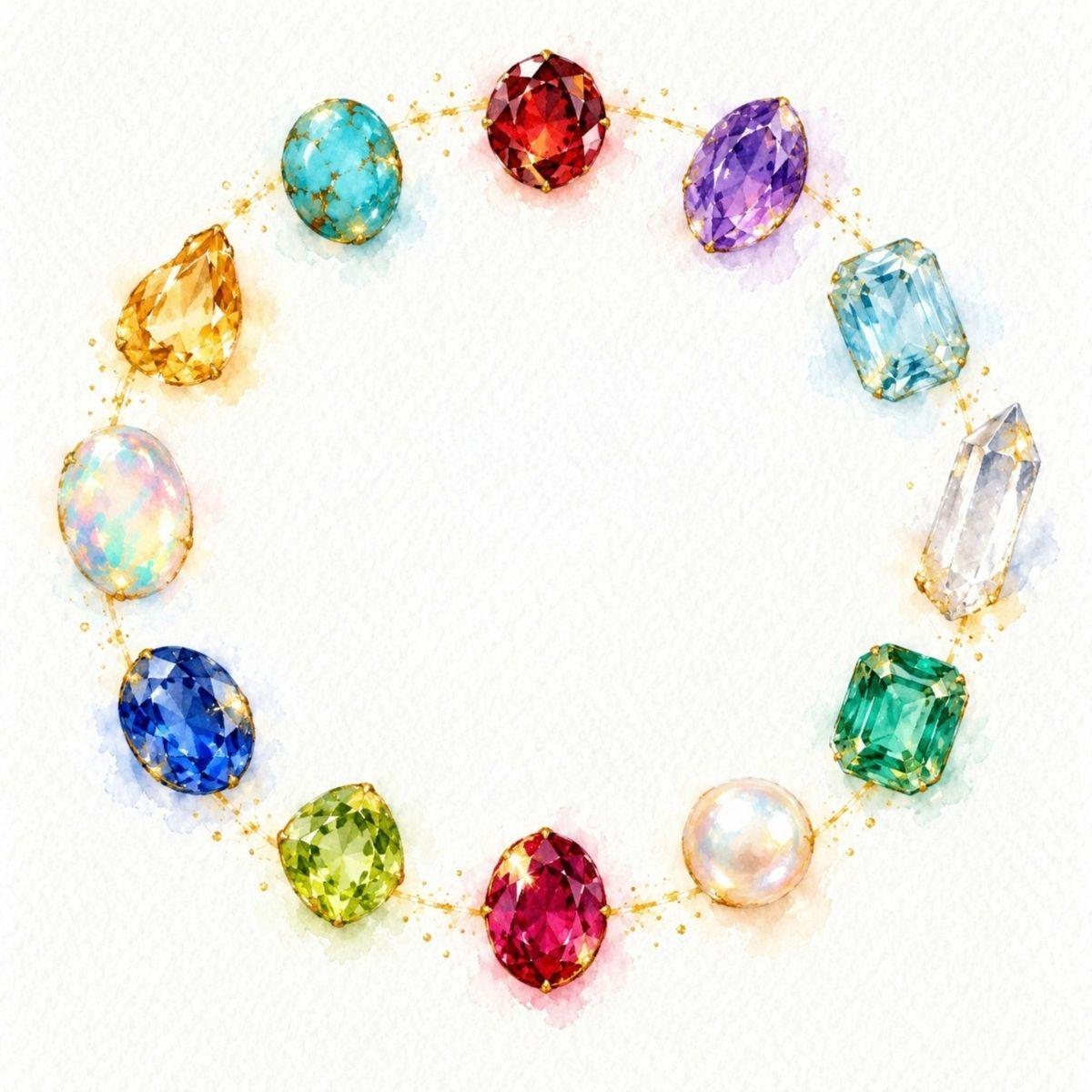
What every month's stone actually carries, why some months got three, and permission to wear one that isn't technically yours. Your front door to all twelve.
Your birthstone is the one piece of crystal lore almost everyone already knows about themselves. You don't have to believe in anything to know that July is ruby and December is turquoise. It's the crystal world's welcome mat.
Which is why it's a shame how much of it is wrong, or at least incomplete. Half the months have more than one stone. The lists don't agree with each other. And nobody tells you the most useful part: you are not obligated to wear yours.
So here's all twelve, straight. Each month links to its full guide and to the pieces, if you'd rather just look.
Pick Your Month
Tap a stone to open that month's full guide. The write-ups for all twelve are further down if you'd rather read before you click.
 January · GarnetRead the guide →
 February · AmethystRead the guide →
 March · AquamarineRead the guide →
 April · Clear QuartzRead the guide →
 May · EmeraldRead the guide →
 June · PearlRead the guide →
 July · RubyRead the guide →
 August · PeridotRead the guide →
 September · SapphireRead the guide →
 October · OpalRead the guide →
 November · CitrineRead the guide →
 December · TurquoiseRead the guide →
Three Things Worth Knowing First
Most months have more than one stone. That isn't a mistake or a marketing invention — it's history. The modern list was standardised in 1912 and has been amended several times since, usually to add an affordable option alongside a rare one. August has three. December has four. You get to pick.
The lists disagree, and that's fine. Traditional, modern and mystical birthstone lists all exist and none of them outranks the others. If your grandmother told you your stone was something different, she wasn't wrong. She was using a different list.
You don't have to wear yours. This is the part I care about most. A birthstone is a starting point, not an assignment. If you're a January baby who has never once felt like garnet, wear the stone for the chapter you're actually in. Nobody checks.

All Twelve Months
January — Garnet
Deep red, root chakra, and far more interesting than "the cheap red one." Garnet is a vitality stone — grounding, steady, the colour of something that keeps going in the middle of a Canadian winter. Fitting, really.
What garnet means → · How to choose and style it → · Shop January →
February — Amethyst
The most recognisable birthstone there is, and the one most likely to already be on your nightstand. Purple quartz, crown chakra, worn to quiet the noise. Also the stone with the best price-collapse story in the business — it was once valued alongside ruby and emerald, until Brazil found rather a lot of it.
What amethyst means → · How to choose and style it → · Shop February →
March — Aquamarine & Bloodstone
Two stones that could not be less alike. Aquamarine is pale, oceanic, throat-chakra — the stone for saying the thing. Bloodstone is dark green flecked with red, and it's the warrior half of the month. Pick whichever March you're having.
The March guide → · Shop March →
April — Diamond (and its honest alternatives)
April drew the expensive card. The good news is that clear quartz has carried the same meaning for far longer — clarity, light, amplification — at a fraction of the cost and with none of the sourcing questions. Sparkle is a look, not a budget.
April's diamond alternatives → · Shop April →
May — Emerald
Heart chakra, green as the first week of a Calgary spring, and the classic stone of love and growth. Genuine opaque-grade emerald is real emerald — just denser and deeper than the transparent gem-grade version, at a fraction of the price.
Emerald meaning → · Shop May →
June — Pearl, Moonstone & Alexandrite
June is the soft month. Pearl for the classic, and moonstone — the threshold stone, the one for every chapter that's turning before it's visible. The third is alexandrite, which reads green in daylight and red-purple under lamplight, and which outprices diamond per carat, so almost nobody actually owns it. (Pink tourmaline gets miscredited to June constantly. It belongs to October.)
The June guide → · Moonstone, in depth → · Shop June →
July — Ruby
The passion stone, and the one people are most surprised to learn they can afford. Real ruby in opaque grade is a rich, dense red that reads as serious rather than sparkly. Carnelian and onyx sit alongside it as July's warmer, earthier options.
The ruby guide → · Shop July →
August — Peridot, Spinel & Sardonyx
The most underrated month on this list. Peridot is that specific yellow-green nothing else does, heart chakra, and it has a way of nudging you out of your own way. Spinel is the modern addition and comes in almost every colour. Sardonyx is the ancient one, banded and quietly beautiful.
The August guide → · Shop August →
September — Sapphire & Lapis Lazuli
Both blue, both throat chakra, entirely different personalities. Sapphire is the polished one. Lapis is the deep, gold-flecked, five-thousand-year-old one that pharaohs wore. September gets truth-telling stones, which feels about right for the month everything goes back to being serious.
The September guide → · Shop September →
October — Opal & Tourmaline
October is the month that refuses to pick a colour. Opal shifts as you move; tourmaline comes in more shades than any other gem family — pink tourmaline being the one everyone recognises, and the one frequently mistaken for a June stone. If you've ever felt like you contain several people, this is your month.
The October guide → · Shop October →
November — Citrine & Topaz
Golden, warm, solar plexus — the confidence months. Citrine is the one I reach for personally when something needs doing and I'd rather not. Topaz is its steadier cousin. Together they're the antidote to a November in the northern hemisphere.
The November guide → · Shop November →
December — Turquoise, Blue Topaz, Tanzanite & Zircon
Four stones and four moods: turquoise the ancient protector, blue topaz the clear winter-sky one, tanzanite the violet-blue newcomer found in exactly one place on earth, and zircon the sparkler that gets mistaken for something synthetic and isn't. December is spoiled and knows it.
The December guide → · Shop December →
Not sure your birthstone is your stone?
It often isn't, and that's allowed. The Gemstone Quiz takes 60 seconds and matches you to the stone for the chapter you're actually in.
Take the Gemstone Quiz →
Buying a Birthstone for Someone Else
Birthstones are the easiest meaningful gift there is, because the research is already done for you. She was born in a month. That's the whole brief.
Which is also the trap. A birthstone bought straight off the list is a correct gift. A birthstone bought with one extra minute of thought is a gift she still wears in four years. The difference is smaller than you'd think, and it's entirely in your hands.
Pick the stone in her month, not the first stone in her month. Half the months have options, and the options are not interchangeable. A March baby who is all warrior and no ocean wants bloodstone, not aquamarine. A June baby who has spent the year in transition wants moonstone, not pearl. A December woman who has protected everyone in her family for thirty years wants turquoise, and she wants it for a reason you can say out loud. Scroll back up to her month and read both stones before you choose.
Say why you picked it. This is the whole gift. The stone does the symbolism; you still have to do the sentence. "It's your birthstone" is a fact. "It's the protection one, and you've been holding a lot this year" is a gift. One line, written on the card in your own handwriting, and the piece stops being jewellery and starts being evidence that someone was paying attention.
If you had to look up her month, that's fine — nobody can tell. Looking it up is not cheating, and there is no version of this where she opens the box and detects research. What she detects is whether the stone suits her. So use the twelve months above as the shortcut they are, then spend your effort on the second half: which of her month's stones sounds like her, and what you're going to write.
You can gift more than one month. Her stone alongside her children's is one of the nicer pieces of quiet symbolism available, and it's the reason a lot of birthstone gifts get worn daily instead of occasionally. Two months in one stack, three if the chain can carry it. There is no rule against mixing months, and there never was.
And if she isn't a crystal person at all — no altar, no moon phases, no interest in any of it — a birthstone still works, because it isn't asking her to believe anything. It's her month. This guide is written for exactly that, and it assumes zero expertise on your part.
One thing to skip: buying the rarest stone in her month because it's the rarest. Alexandrite outprices diamond and almost nobody owns it; that's a fact about supply, not about her. Grade drives price far more than authenticity does, and a genuine opaque-grade ruby is a real ruby. Spend the difference on the piece she'll actually wear.
On sizing, before you ask: earrings and stretch or adjustable bracelets need no size at all, which makes them the safe default when you're guessing. Many necklaces here offer a choice of 41 cm / 16 in, 46 cm / 18 in or 51 cm / 20 in on the product page; where there's no selector, the length is stated in the description. Picking blind? 46 cm / 18 in sits just below the collarbone and suits almost everyone.
Ready to shop it rather than read about it? Every month's stones are here, and the wider Gift Guide sorts by price, by meaning and by recipient if the month isn't the angle you need.
Caring for a Stone You'll Wear Constantly
A birthstone is usually worn hard, because it's personal. Most take a soft cloth and gentle care. A few — pearl, opal, moonstone, turquoise — are softer or porous and genuinely dislike chemicals, ultrasonic cleaners and being stored next to anything harder than they are.
The stone-by-stone method is in the Crystal Care Guide. For the energetic side — resetting a stone rather than cleaning it — the crystal cleansing guide is the one you want.
Keep Reading — the Other Front Doors:
- The Complete Crystal Guide: Where to Start
- Chakras for Beginners
- Moon Magic: Every Moon Ritual Guide
- Are Lab-Created Gemstones Real?
- Crystal Properties Guide (full reference)
- The Gift Guide: Every Way to Choose One
Find Your Month
Twelve months, twenty-odd stones, and no rule that says you have to stay in your lane.
Shop birthstones by month → — or take the quiz and see whether your birth month and your actual stone agree.
Andrea 🌙
Mystic Soul Jewelry
Join The Circle.
15% off your first order (good for 7 days), plus the Birthday Club, so your month gets remembered too.
Join The Circle →
FAQ
Q: Why do some months have more than one birthstone?
A: The modern list was standardised in 1912 and amended several times since, usually to add an affordable or more available option beside a rare one. August and June each have three, and December has four. All of them count.
Q: What's the difference between traditional, modern and mystical birthstones?
A: Three separate lists from three separate traditions. The modern list is the one most jewellers use, the traditional list is older and regional, and the mystical list comes from Tibetan tradition. None outranks the others — if your family always said your stone was something else, they were using a different list.
Q: Is pink tourmaline a June birthstone?
A: No — tourmaline is October's birthstone, alongside opal. Pink tourmaline gets miscredited to June fairly often because it pairs so naturally with pearl, and a pearl-and-tourmaline piece genuinely spans both months. But on its own, it's October's.
Q: Do I have to wear my own birthstone?
A: No. A birthstone is a starting point, not an assignment. Plenty of people find the stone for the chapter they're in is nothing like their birth month, and wearing that instead is completely normal.
Q: Can I wear more than one birthstone?
A: Yes — and it's one of the nicer ways to layer. Your own stone plus your children's, or a partner's, is a common stack. There's no rule against mixing months.
Q: Is a real birthstone always expensive?
A: No, and this is the most useful thing to know. Grade drives price far more than authenticity does. A genuine ruby, emerald or sapphire in opaque grade is completely real — just denser and deeper in colour than transparent gem-grade — and costs a fraction of the price.
Q: What's the best birthstone gift for someone who isn't into crystals?
A: Choose the stone in her month that matches her personality rather than the default, and tell her why you picked it. The month does the work; the sentence makes it land.
Q: What necklace length should I buy as a gift?
A: 46 cm / 18 in if you have to guess — it sits just below the collarbone and works on almost everyone. Many necklaces here offer a choice of 41 cm / 16 in, 46 cm / 18 in and 51 cm / 20 in on the product page; where there's no selector, the length is stated in the description. Earrings and adjustable bracelets remove the question entirely.


