

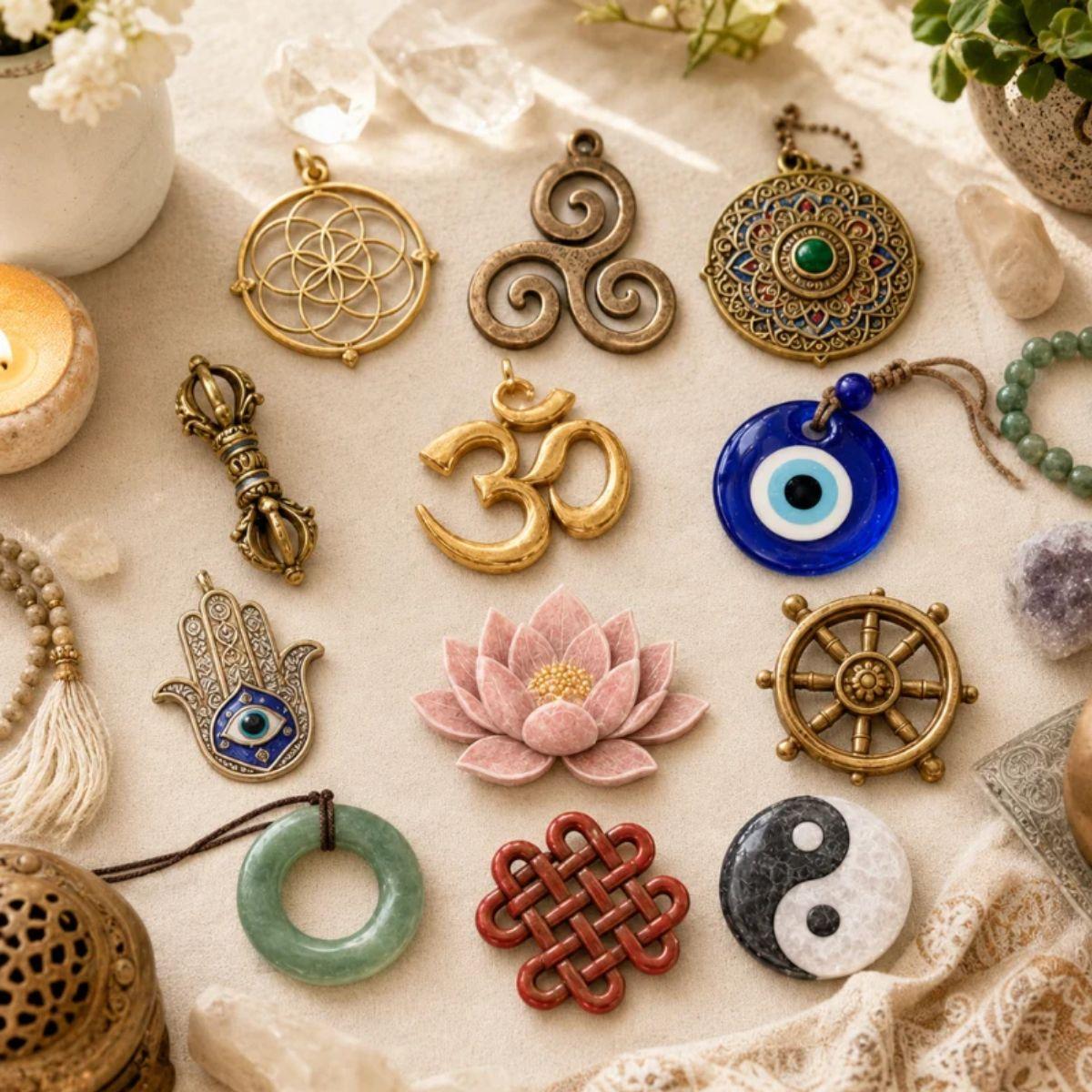
Which sacred symbol is mine? Start with what you need right now. Protection: the hamsa or the evil eye. Intuition: the third eye. A new chapter: the lotus. Roots and growth: the tree of life. Connection: the flower of life or infinity. Still torn? The 60-second Gemstone Quiz matches you to the stone and intention for the chapter you're in.
Pick by what you need:


If you buy one thing

Hamsa Hand Necklace · Dusk or Emerald · $45
Of every symbol on this page, this is the one I reach for. I wear a hamsa almost every day: a small hand resting on my chest, bringing peace or whatever I need in the moment. I paired it with Dusk glass because it's my favourite colour, the one that moves with you in the in-between. Handmade in Calgary by me.
I started getting asked the same questions at every market show.
What does the Hamsa mean? Is the Lotus religious? What's that blue eye thing, and is it the same as the Third Eye?
So I wrote the guide.
Eleven symbols that have been worn for thousands of years, across traditions that don't agree on much. Trace each one back and they keep arriving at the same handful of human truths. Protection. Connection. Cycles. Rebirth. The unbroken thread.
I wear symbols because they say the thing I don't always have words for. I suspect you do too.
Here's what each one means, the stones that pair with it, and the pieces that carry it. If a stone name catches your eye, the A–Z crystal properties guide has the full story. When you've read these eleven, part two, Twelve Symbols, One Sealed, picks up the butterfly, spiral, scarab, feather and the angel wing.
New to this? You don't need to start with the statement piece. A stud or a single bracelet carries the same symbol as anything else on this page. The point is wearing it, not spending on it.

🌸 Flower of Life — Sacred Geometry, Interconnectedness & Creation
The Flower of Life is nineteen overlapping circles, each one blooming from the one before it. Versions of it turn up burned into the pillars of the Temple of Osiris at Abydos in Egypt (the dating is contested), in the Forbidden City, in synagogue mosaics, and in Leonardo da Vinci's notebooks, where he worked out the proportions inside it.
What it's saying: everything that exists is connected. Every life form, every element, every cycle of growth. Same pattern, different expression.
Wear it when: you're in a season that feels fragmented, and you need the reminder that even the scattered parts belong to a larger, still-coherent whole. Full guide: Flower of Life Meaning: The Oldest Pattern in the World →
Pairs with: Clear Quartz (clarity), Moonstone (cycles), Labradorite (cosmic connection).

🔵 Mandala — Higher Consciousness, Harmony & Meditation
Mandala means "circle" in Sanskrit. In Tibetan Buddhist practice, monks spend days, sometimes weeks, laying coloured sand into an intricate mandala, then sweep it away on purpose and pour the sand into moving water. The point was never the object. The point is the practice.
A mandala is a map of a whole world, every element radiating from a central point. Worn as jewelry, it's a reminder that the outer rings can change and the centre comes with you.
Wear it when: the noise is loud and you need a focal point. Or when something you built is ending, and you'd like to believe it wasn't wasted.
Pairs with: Amethyst (Crown Chakra), Clear Quartz (clarity of purpose).

Not sure which symbol is for the chapter you're in?
The Gemstone Quiz takes 60 seconds and matches you to the stone, and the intention, that fits right now.
🕉️ Om (Aum) — Sacred Sound of the Universe, Intuition & Oneness
Om, written ॐ in Sanskrit, is considered the original sound: the vibration the universe began with. It opens and closes Hindu prayers, yoga practice and Buddhist mantras. It's a sound before it's a word.
The symbol holds four parts: the waking state, the dreaming state, deep dreamless sleep, and, in the small curve at the top, the awareness that contains all three. Which is why Om is said to contain everything.
Wearing Om doesn't mean claiming a religion. It's a reminder that under the noise of the day there is something steady. It was there before the inbox, and it will be there after.
Wear it when: you're returning to a practice. Starting meditation. Coming back to yourself after a season that pulled you off-centre. The full story: Om Meaning: The Sound Everything Started With →
Pairs with: Amethyst (Crown Chakra), Moonstone (intuition), Sodalite (inner truth).

🧿 Evil Eye (Nazar) — Protection from Negativity, Jealousy & Harm
The Evil Eye, specifically the Nazar boncuğu, the blue glass bead, is one of the oldest protection amulets people have made. It appears in ancient Egypt, Greece, Rome, Turkey, the Middle East and across the Mediterranean. Dozens of cultures, one consistent belief: the envious gaze of others can carry harm, and this symbol reflects it back.
The concentric circles of the Nazar, deep blue, light blue, white, dark centre, mimic an eye. It sees the harm coming and deflects it before it reaches you. In Turkey you'll find it in homes, on babies, on cars, on jewelry. Not as decoration. As protection, taken seriously.
Important distinction: the Evil Eye is not the Third Eye. The Evil Eye is a protection amulet with concentric circles, from Mediterranean and Middle Eastern tradition, and it deflects harm. The Third Eye is an intuition symbol from Eastern tradition, usually drawn with sunburst rays, and it's about inner knowing. Both are valid. They are not interchangeable. Full guide: Evil Eye Meaning: History, Protection & How to Wear It →
Wear it when: you're in a season heavy with other people's energy, and you'd like something that's been saying "not today" for thousands of years.
Pairs with: Black Tourmaline, Labradorite, Obsidian.
Or see it beside every other protective piece in Protection Jewelry.

🤲 Hamsa — Protection, Intuition & Blessings
The Hamsa is an open hand, often with an eye in the centre, worn across Jewish, Islamic and North African traditions as a protection symbol. In Hebrew and Arabic, "hamsa" means five: the five fingers. Some know it as the Hand of Fatima, some as the Hand of Miriam. Across faiths that have disagreed on almost everything for centuries, the open hand means the same thing.
The eye in the centre of many Hamsa designs is the Evil Eye: protection within the protection. Open hand outward, no harm enters here. Eye within, I see what's coming.
Wear it when: you want to lead with openness and still feel protected. The Hamsa doesn't close you off. It extends a hand and says: welcome, and also, this far and no further. Full history: Hamsa Hand Meaning →
Pairs with: Rose Quartz (open heart, protected spirit), Moonstone, Evil Eye pieces as a set.
Or browse the wider Protection Jewelry collection.

👁️ Third Eye — Intuition, Inner Vision & Knowing Before You Can Explain It
The Third Eye is the sixth chakra, Ajna, the space between the eyebrows. In Eastern traditions it's the seat of perception beyond the five senses: intuition, insight, the knowing that arrives before the reasoning catches up.
You recognise it by the rays. A Third Eye is usually drawn as a single eye with sunburst lines radiating outward, light coming from the eye rather than being deflected by it. That's the whole difference from the Evil Eye, and it's the question I get asked most.
Wear it when: you already know the answer and keep talking yourself out of it. When you're learning to trust the first instinct instead of the fourth opinion. Full guide: Third Eye Jewelry: For the Ones Who See Before They Look →
Pairs with: Amethyst and Lapis (Third Eye Chakra), Labradorite, Moonstone.

🌳 Tree of Life — Roots, Growth & Everything Connected Underground
The Tree of Life appears in Celtic, Norse, Egyptian, Jewish and Buddhist traditions independently, which tells you how obvious the metaphor is once you've stood under a big tree. Roots going down as far as the branches go up. Nothing visible without the part you can't see.
In Celtic tradition the tree connected the underworld, the earth and the sky. In Kabbalah it maps the structure of creation. Every version agrees: you are not separate from where you came from, and growth in one direction takes depth in the other.
Wear it when: you're building something and need the reminder that the invisible work counts. Or when family, the one you were born into or the one you made, is on your mind. Full guide: Tree of Life Meaning →
Pairs with: Green Aventurine (growth), Moss Agate (renewal), Smoky Quartz (roots).

🧡 Lotus Flower — Enlightenment, Purity of Heart & Rebirth
The Lotus roots in muddy water and rises to bloom clean above the surface. That's the plant's real biology, and it's exactly why every major Eastern tradition chose it as the symbol of awakening.
In Buddhism, the Lotus is the path from suffering to awakening: rooted in the mud of the material world, growing through the water of experience, blooming in clear air. In Hinduism, deities sit on Lotus thrones. In Egyptian tradition, the Blue Lotus belonged to the sun, creation and rebirth.
Worn as jewelry, the Lotus is the piece for the woman who has come through seasons she didn't choose, and wears the reminder that blooming and being rooted in difficulty were never opposites.
Wear it when: you're in a chapter of becoming. Or when you need to remember that where you started doesn't decide where you're going. Full guide: Lotus Flower Meaning →
Pairs with: Rose Quartz (Heart Chakra, self-compassion), Moonstone (rebirth, cycles), Amethyst.
Or start a chapter properly in New Beginnings Jewelry.

♾️ Infinity — No Beginning, No End, No Explanation Required
The infinity loop is the simplest symbol here and the one people reach for most often, usually for someone else. A single line that crosses itself and returns, with no start, no finish, and no point where it becomes something different.
As a mathematical sign it dates to 1655. As an idea it's much older, and close kin to the Endless Knot of Tibetan Buddhism: things woven together that can't be pulled apart. In everyday use it's become the symbol of the love that doesn't need a start date. Partners, mothers, daughters, the friend who's been there thirty years.
Wear it when: you want to carry a connection without announcing it. Or when you're marking something that was true before you named it. Full guide: Infinity Symbol Meaning in Jewelry →
Pairs with: Rose Quartz (unconditional love), Garnet (deep, rooted love), Moonstone (cycles, the long view).

🔢 Angel Numbers — The Symbol That Comes Looking for You
Every other symbol on this page, you go looking for. Angel numbers come looking for you. 11:11 on the clock. 222 on the car ahead, three mornings running. 444 on a receipt at the end of a long week.
Read in order, the numbers tell one story. One begins. Two waits. Three makes. Four holds. Five moves. Six rebalances. Seven confirms. Eight circulates. Nine closes. Then it starts again.
A number is the most private symbol you can wear. Nobody reads it across a room. You know what it says, and that is the point.
Wear it when: the same number has turned up often enough that you've stopped pretending you didn't notice. Every number, what it's telling you and the stone that pairs with it: the angel numbers guide →
Pairs with: the number's own stone. Clear quartz for 1111, carnelian for 333, hematite for 444, citrine for 888.

☸️ Prayer Wheel — Mantra in Motion, and Something to Do With Your Hands
In Tibetan Buddhist practice, a prayer wheel is a drum holding a tightly wound scroll of mantra, most often om mani padme hum, turned clockwise. Each turn is held to be the equivalent of reciting the words inside. The prayer becomes something your hands do, not something you have to find the words for.
Worn as a pendant, that translates beautifully. Two of mine spin and open into a small vessel, so you can turn it between your fingers in the waiting room and keep your own words inside. The third is handmade in Tibet and does neither; it's the one for the object itself.
It's the most practical symbol in this guide, and I mean that as a compliment. Anxiety wants your hands busy. This gives them somewhere to go that means something.
Wear it when: your mind runs and your hands need a job. When you'd rather carry the words than remember them. Full guide: Prayer Wheel Meaning: The Mantra You Don't Have to Say Out Loud →
Pairs with: Amethyst (calm), Smoky Quartz (grounding), Clear Quartz.

The Thread Through All of It
Eleven symbols. Dozens of cultures. Thousands of years.
Every one of them is saying something about the same small set of things: you are protected. You are connected. You are in motion, and the motion means something. You are part of something with no beginning and no end.
That's what I mean when I say symbols say the thing you don't always have words for. You don't have to be Buddhist to feel what a prayer wheel is pointing at. You don't need the full history of the Hamsa to feel what it means to wear an open hand. The symbols do the pointing. You bring the meaning.
The pieces in the Spiritual Symbols collection range from genuine stone and real silver to waterproof stainless steel, and every listing says which, so you know what you're wearing and why. Keeping them looking like themselves is the easy part: my guide on how to clean silver, plated and stone jewelry covers every finish.
Because you deserve to know what your jewelry means.
Not sure which piece is yours right now?
The Gemstone Quiz takes 60 seconds and tells you which stone fits the chapter you're in.
Keep Reading: Every Symbol Guide
- Twelve Symbols, One Sealed (part two)
- Flower of Life Meaning: The Oldest Pattern in the World
- Om Meaning: The Sound Everything Started With
- Prayer Wheel Meaning: The Mantra You Don't Have to Say Out Loud
- Evil Eye Meaning: History, Protection & How to Wear It
- Hamsa Hand Meaning
- Third Eye Jewelry: For the Ones Who See Before They Look
- Tree of Life Meaning
- Lotus Flower Meaning
- Infinity Symbol Meaning in Jewelry
- Angel Numbers and Jewelry: What 111 to 999 Mean
- Butterfly Meaning in Jewelry
- Protection Jewelry: What to Wear When You Need a Boundary
- What Does a Ring on Each Finger Mean?
- The Crystal Properties Guide: every stone named above, A to Z
Frequently Asked Questions
Which sacred symbol is mine?
Start with what you need right now. Protection: the hamsa or the evil eye. Intuition: the third eye. A new chapter: the lotus. Roots and growth: the tree of life. Connection: the flower of life or infinity. If you keep looking at one, that's usually your answer. Still torn? The Gemstone Quiz takes 60 seconds.
What is a good sacred symbol necklace to start with?
A small one you'll wear every day. The Hamsa Hand Necklace ($45) is the one I wear myself: a hamsa and crescent moon with a faceted glass teardrop in Dusk grey or Emerald green, gold or silver plate, made by hand in Calgary. The hamsa is the protection symbol worn across the most traditions, which makes it an easy first symbol.
What is the difference between the Evil Eye and the Third Eye?
They are different symbols with different origins. The Evil Eye (Nazar) is a protection amulet from Mediterranean and Middle Eastern traditions, recognisable by concentric blue circles, and it deflects harm. The Third Eye is an intuition symbol from Eastern traditions, usually drawn with sunburst rays, and it's about inner knowing. Concentric circles means Evil Eye. Rays means Third Eye.
What do angel numbers mean in jewelry?
Angel numbers are repeating sequences that turn up often enough to feel like a message. Read in order they tell one story: 1111 begins, 222 trusts the long middle, 333 creates, 444 stands on the foundation, 555 moves, 666 rebalances, 777 confirms, 888 flows and 999 releases. Worn as jewelry, a number is the most private symbol you can carry. The angel numbers guide covers each one and its stone.
Is it disrespectful to wear symbols from other cultures?
It's a question worth taking seriously, and no single answer covers every symbol. What matters is intention and understanding. Wearing a symbol because it's pretty, with no idea what it means, is different from wearing it because you know its history and feel a genuine resonance. This guide exists for that reason. Wear with knowledge, wear with respect, and remember these symbols were made to be carried, not collected.
Where do I start if I've never worn a symbol before?
With whichever one you keep looking at. Recognition is the whole mechanism. Practically: start with a small piece you can wear daily rather than save for occasions. A stud, a slim bracelet, a simple ring. The symbol does the same work at any size, and a month of living in it tells you more than deliberating over the bigger version.
What does a prayer wheel necklace do?
In Tibetan Buddhist practice, a prayer wheel holds a written mantra and is turned clockwise, each turn treated as a recitation of the words inside. Worn as a pendant, it gives you a physical practice: something to turn between your fingers when your mind is running. Two of the pieces here spin and open into a small vessel for your own written words; the handmade Tibetan piece is decorative and does neither.
What is the Flower of Life symbol?
The Flower of Life is a sacred geometry pattern of nineteen overlapping circles in a hexagonal grid. It appears at the Temple of Osiris at Abydos in Egypt (the dating is debated), in the Forbidden City, in synagogue mosaics and in Leonardo da Vinci's notebooks. It stands for the interconnectedness of all life. The full Flower of Life guide covers its origins and what's hidden inside the pattern.
What does the Tree of Life symbolize?
Roots and branches as one system: growth upward takes depth downward. It appears independently in Celtic, Norse, Egyptian, Jewish and Buddhist traditions. In Celtic tradition it connected the underworld, earth and sky. In Kabbalah it maps the structure of creation. Every version agrees you are not separate from where you came from.
Can I wear multiple symbols at once?
Yes, and many people do. Layering symbols is a way of wearing several intentions at once. A Hamsa for protection, a Lotus for the chapter of becoming, an Infinity loop for the love that grounds you. Wear what calls to you, and know what each piece is doing.
What does it mean when a symbol "chooses" you?
Usually it means your eye keeps returning to it. You see it on someone else and can't stop looking. You read the meaning and it describes exactly the chapter you're in. That's recognition. People have used symbols for thousands of years because some truths are easier to wear than to say out loud.
Mystic Soul Jewelry — Canadian small business, Calgary, Alberta, since 2008.
Want the next symbol guide in your inbox when it goes up? Join The Circle. It's my list, it's free, and 15% off your first order and the Birthday Club come with it. Next up: the mandala, and why the monks sweep it away.
— Andrea


