

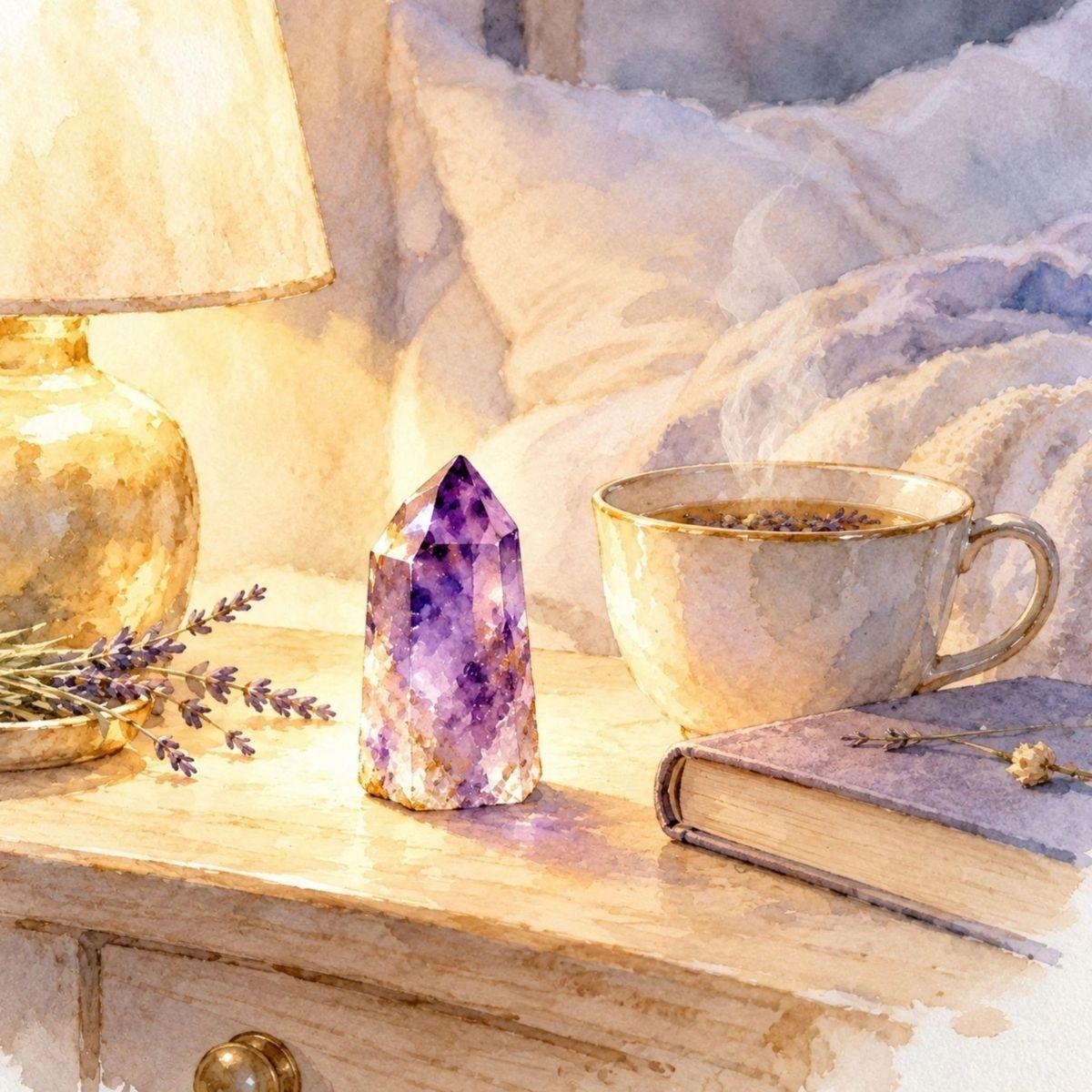
When your head won't stop, you reach for small anchors. A breath. A pause. Something you can touch that reminds you where you are.
That's what amethyst is for — not as treatment, but as a physical cue you can carry. This guide is the practical version: how to use it daily, a ten-minute ritual for the days that get away from you, and which pieces work best when the point is touching the thing rather than looking at it.
If you're still choosing a stone, start with The Best Crystals for Anxiety — six stones, matched to six kinds of anxious. This one is the deep end for amethyst alone. And if you're newer to stones generally, The Complete Crystal Guide is the front door to all of it.
Quick Shop — pieces you'll touch: All Amethyst Jewelry | Mudra Bracelet | Amethyst Ring | Double Teardrop Pendant | Exquisite Necklace (purple glass)
Jump To: The Honest Part | Why Touch Matters | Daily Practice | The 10-Minute Ritual | Affirmations | Which Piece to Wear | FAQ
The Honest Part, First
Amethyst is not medicine. It will not treat anxiety, and anyone who tells you otherwise is selling you something.
What it does do is give you a physical object attached to a decision you already made. You decided to pause. You decided that your energy stays yours. The stone is where that decision lives, so you can find it again at 3pm when you've forgotten.
That's not nothing. Most of the useful things in a calm practice are that simple — a cue, repeated, until it becomes automatic. But it's also not a substitute for real support. If you're navigating significant or persistent anxiety, please talk to a qualified mental health professional. A necklace is a good reminder. It is not a treatment plan.
Everything below is written on that basis.
Why Touching It Matters More Than Wearing It
Here's the part most crystal guides skip.
A stone you can see is a decoration. A stone you can reach for is a practice. When your chest tightens in a meeting, you can't sit down and meditate — but you can put two fingers on a pendant and take one slower breath, and nobody at the table notices.
That's the whole mechanism: a small physical action, available anywhere, attached to a specific intention. The stone doesn't do the work. It makes the work findable.
Which is why, for anxiety specifically, I'd point you toward pieces you contact rather than pieces that just look good:
- Bracelets — your wrist is already in your field of view a hundred times a day
- Rings — the most touchable of all, and turning one is a habit most people already have
- Pendants — sit at the chest, easy to reach, discreet in public

The Mudra Bracelet — double strand, sits where you'll notice it. Shop the Mudra Bracelet →
Daily Practice — Three Options, Pick One
Consistency beats ceremony. One small thing done most days will do more than an elaborate practice you abandon in a fortnight.
Morning — ten seconds. Hold your amethyst. Choose one word for the day: steady, clear, protected. That's it. Put it on and go.
Midday — one minute. Touch the piece. Inhale for four, exhale for six. Three rounds. The long exhale is the part that matters — it's the signal your body reads as safe.
Evening — the handover. Take it off deliberately and set it somewhere specific. Not dropped on a counter — placed. That small deliberateness is what makes it a boundary between the working day and the rest of it.
Pick one. Not all three. The one you'll do.
The 10-Minute Ritual — for the Days That Got Away From You
For when you're wired, overloaded, or emotionally full. No special setup, no perfect timing.
1. Sit down. (1 minute)
One hand on your chest, one holding your amethyst. Let your shoulders drop — they're probably up around your ears.
2. Breathe. (2 minutes)
Inhale four, exhale six. Six to eight rounds. Don't count perfectly; the point is the longer exhale, not the arithmetic.
3. Name it. (2 minutes)
Say it out loud if you can: "Right now, I'm carrying ______."
Then: "I'm allowed to set this down for today." Not forever. Today.
4. Choose. (3 minutes)
Pick one — calm, clarity, or protection.
"I choose ______, gently and consistently."
5. Close. (2 minutes)
Touch the stone: "My energy stays mine. I'm safe to soften."
The naming step is the one people skip and the one that does the most. Vague dread stays vague until you make it say its name.

If moon-cycle practice is your thing, the New Moon Rituals guide uses the same structure on a monthly rhythm.
Amethyst Affirmations
Use one. Repeating six is a to-do list, not a practice.
- I release what's not mine to carry.
- I return to calm, one breath at a time.
- Clarity comes when I soften my grip.
- I am protected, grounded, and steady.
- I can feel deeply without drowning in it.
- Peace is a practice — and I'm practicing.
Which Amethyst Piece to Wear
For a calm practice specifically, choose by how often you'll touch it, not by how it photographs.
If you fidget: the Amethyst & Mother of Pearl Ring. Turning a ring is already a habit for most people — this just gives the habit a meaning.
If you're a wrist person: the Mudra Bracelet. Double strand, visible every time you check the time.
If you want it discreet: the Amethyst Double Teardrop Pendant. Sits at the chest, reachable without anyone noticing you're doing anything.
If you want the stone itself on you: the Amethyst Vial Earrings hold real amethyst chips in a tiny glass vessel.
Or take the long way round and browse the full amethyst collection, and pick the piece that already looks like something you'd reach for.

Shop the Amethyst & Mother of Pearl Ring →
For shade and pairing, the amethyst meaning guide. For metal, quality and gifting, the February birthstone jewelry guide. And if you're buying this for someone whose month isn't February, which months get which stones sorts that out in one page.
Not sure amethyst is the right stone for what you're carrying?
The Gemstone Quiz takes 60 seconds and matches you to the stone that fits the chapter you're in.
→ Take the Gemstone Quiz
Looking After It
Lukewarm water, mild soap, soft brush, pat dry. Keep it out of prolonged direct sunlight and off hot windowsills — amethyst does fade.
I found that out the expensive way, and wrote about it in the amethyst meaning guide. Here's the full routine for how to clean amethyst jewelry.
FAQ — Amethyst for Anxiety
Does amethyst help with anxiety?
Not as treatment. Amethyst works as a mindfulness anchor — a physical object you can touch that reminds you to pause and breathe. The benefit comes from the practice, not the mineral. That said, a cue you can carry and use anywhere is useful, and consistent small resets add up. It is not a replacement for professional support.
Where should I wear amethyst for anxiety?
Wherever you'll touch it most. Amethyst is traditionally linked to the crown and third eye chakras, which favours pendants and earrings — but for anxiety specifically, contact matters more than placement. Rings and bracelets tend to work best because you reach for them without thinking.
How long does the ritual take to work?
The breathing part works immediately — a longer exhale shifts your state within a minute or two. The habit part takes a few weeks. You're building an association between a physical object and a calmer state, and associations need repetition. Do the short daily version rather than the full ritual occasionally.
Can I wear amethyst every day?
Yes — which is rather the point for this kind of practice. At 7 on the Mohs hardness scale it handles daily wear well, especially in necklaces and earrings. Rings work with a secure setting; take them off for washing up and workouts.
Can amethyst help with sleep?
Many people keep amethyst on the nightstand as a wind-down cue. The stone has no sleep-inducing properties — but the deliberate act of placing it before bed marks a boundary between the day and the night, and that boundary is what helps. The ritual is the useful part.
Does amethyst need to be cleansed?
Only if the ritual means something to you. Sound, intention-setting, or a night somewhere quiet all work. Avoid salt water and direct sunlight — salt damages metal settings and sunlight fades the purple permanently. The crystal cleansing guide covers the methods that are safe for set stones. For physical cleaning, mild soap and water is enough.
What if my amethyst is glass or lab-created?
It works the same, because the mechanism is the practice rather than the material. Lab-grown amethyst is chemically identical to natural. Glass is a different material but a perfectly good carrier for an intention when it's clearly labelled. The lab-grown gemstones guide covers the difference.
Which is better for anxiety — amethyst or another stone?
Depends what the anxiety feels like. Amethyst suits mental noise and overthinking. If it's more like restlessness, or grief, or a boundary problem, a different stone may fit better. The Best Crystals for Anxiety compares six of them without the hype.
Keep Reading
- Shop All Amethyst Jewelry →
- The Complete Crystal Guide: Where to Start →
- The Best Crystals for Anxiety: 6 Calming Stones →
- What Amethyst Means →
- February Birthstone Jewelry Guide →
- Birthstones by Month: All Twelve →
- Chakras for Beginners →
- Crystal Properties Guide →
The calm you're looking for doesn't have to be dramatic. Sometimes it's a breath, a boundary, and something you can hold onto.
Andrea 🌙
Join The Circle.
15% off your first order (good for 7 days), plus the Birthday Club, so your month gets remembered too.
Join The Circle →
Mystic Soul Jewelry — Canadian small business, Calgary, Alberta, since 2008. Clearly labelled, always.


