

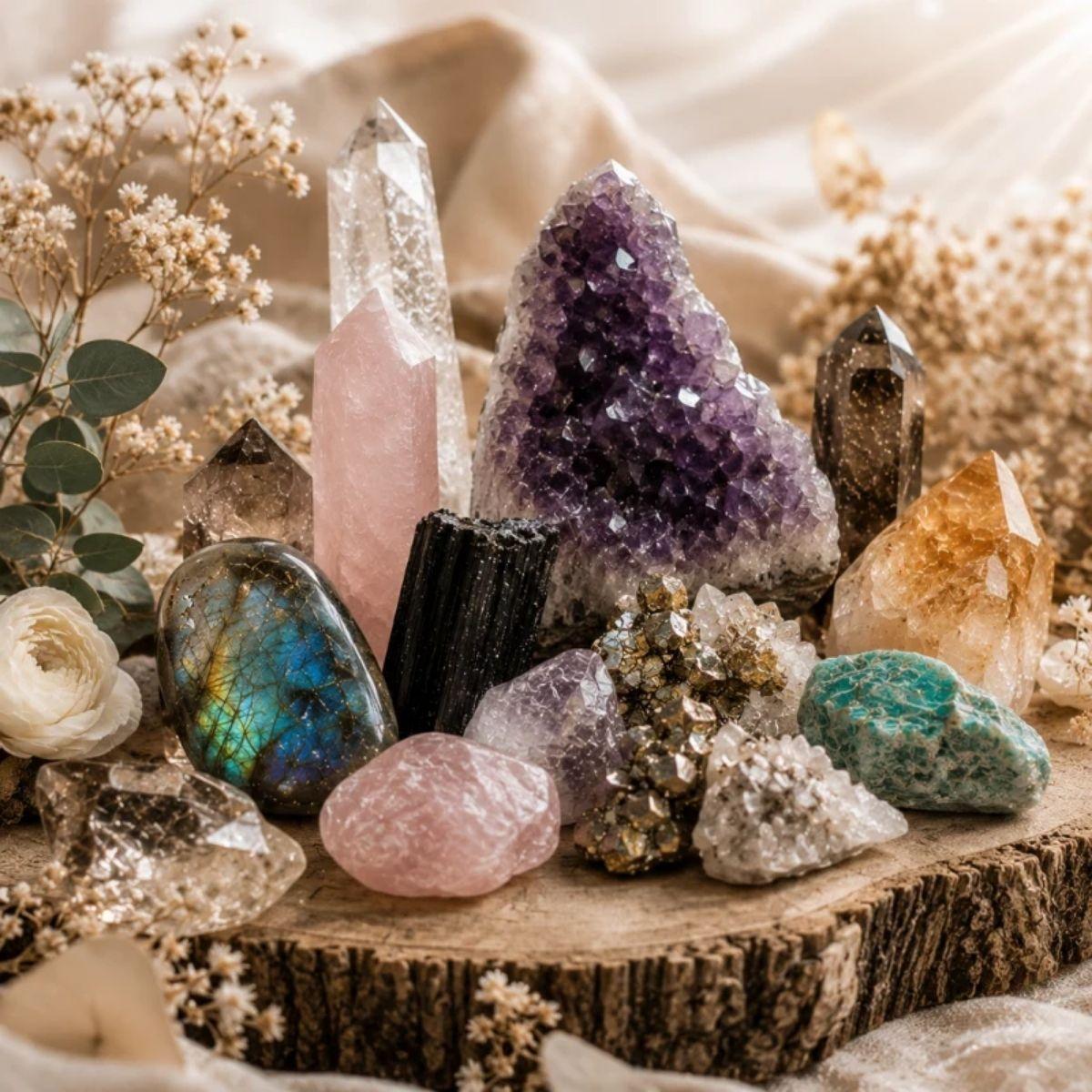
How crystals work as a practice, how to choose the one for the chapter you're in, and where to go deep on any stone. Your front door to everything.
Most crystal guides are written for someone who's never held one. This one isn't.
You already know your sun, your rising, probably your moon. You've had a rose quartz on your nightstand for a decade. You don't need "crystals are rocks with energy" — you need the grown-up version: how to use them, how to choose the right one when your life shifts, and where to look when you want to go deep on a specific stone.
The short version: choose a crystal by what your chapter is asking for — calm, courage, grounding, softness, or a way through a transition — then wear it where you'll see and touch it every day. The stone is the reminder; you do the work. Every stone guide I've written is linked below, sorted by need.
So consider this your front door. Everything you need is one click from here — and I'll tell you exactly where to go for what.

First, the Only Rule That Matters
Here's my whole philosophy in one sentence: the stone doesn't do the work. You do. It keeps you company while you do it.
That's the difference between what I make and what half the internet sells. I'm not going to tell you a crystal will fix your anxiety, fix your marriage, or produce a Range Rover. What it will do is sit on your wrist as a reminder — of the boundary you set, the intention you named, the softness you're choosing. A companion, not a cure.
Once you hold crystals that way — as touchstones, not magic — the whole practice gets more honest and more useful. You stop waiting for the rock to change your life and start letting it remind you to change it yourself.
How to Choose Your Crystal
There are four ways women find their stone. All are valid. You've probably used most of them without noticing.
By intention — what your chapter is asking of you. This is the big one. You're not shopping for a color; you're reaching for what you need. Grounding for a scattered season. Softness for a hard one. Courage for the thing you keep almost starting. Match the stone to the moment, not the outfit.
By intuition — the one you can't stop looking at. Sometimes a stone just catches you. You keep coming back to it and can't say why. That's not nothing — that's usually your gut naming something before your head can. Trust it. The one you're drawn to is often the one for the chapter you're in. If it's the color pulling you, What Does Each Crystal Color Mean? decodes it.
By chakra — where your attention wants to go. If you track energy centers, this is a clean map: root for grounding, heart for opening, throat for truth, crown for intuition. New to the chakra system, or want a refresher past the beginner version? Start with Chakras for Beginners.
By timing — where the moon is. Some women work the lunar calendar instead of the chakra map: new moons for setting, full moons for releasing. If that's you, the Moon Magic hub is the companion to this one — every moon ritual guide in one place.

Not sure which stone is for the chapter you're in?
The Gemstone Quiz takes 60 seconds and matches you to your stone.
The Stones, by What You're Reaching For
Rather than list 50 crystals alphabetically (that's what the full Crystal Properties reference is for), here's the way women think about it — by need. Each links to the deeper story, and to the pieces if you'd rather just look.
When you need to calm down
The racing mind, the tight chest, the 3am spins. Amethyst is the classic — worn to quiet the noise. The amethyst meaning guide covers what it's good for, and Amethyst for Stress & Anxiety has the daily practice and a ten-minute ritual. Black tourmaline for when the anxiety came from outside you. Rose quartz for when it sounds like self-criticism. All six calming stones, side by side, are in The Best Crystals for Anxiety.
When you're in transition
The move, the empty nest, the chapter turning before it shows up. Labradorite is the stone for the in-between — read the Labradorite guide, or go straight to the Labradorite collection. Moonstone is its softer cousin, the threshold stone — Moonstone Meaning covers it, and the Moonstone collection has the pieces.
When you need confidence and fire
The meeting, the ask, the thing you've been playing small about. Citrine for your own light, tiger's eye for the nerve, carnelian for the guts to begin. Warm stones for the woman done dimming. Already made the decision and still haven't done the thing? Tiger Eye Meaning is the stone for exactly that gap.
When you want grounding and a clear head
Scattered, buzzing, can't land. Smoky quartz and hematite bring you back to earth — both feet on the ground, present-moment stones. Rutilated quartz is the interesting one here: clear quartz shot through with fine needles of rutile, gold or black or pink, each doing a slightly different job. The Rutilated Quartz guide explains which is which, and the Rutilated Quartz collection is where the pieces live.
When you're opening your heart
Softness toward yourself or others. Rose quartz leads here — not a slogan on a poster, just a small pink nudge to ease off your own back. If you're in the second half of your life and rose quartz feels like it belongs to someone younger, Rose Quartz Meaning After 50 is the one to read. The Rose Quartz collection is here.

For the complete stone-by-stone reference — every meaning, use, and pairing — the Crystal Properties Guide is your library. To see everything in one place, shop by stone.
Real Stone, Honest Grade, Honest Price
One thing that sets an informed buyer apart: knowing that grade, not authenticity, drives price. A genuine ruby, emerald, or sapphire can cost a fraction of a fine-jewelry stone and still be completely real — it's just opaque-grade rather than transparent gem-grade. Same mineral, same earth, denser and deeper in colour, a fraction of the price. Real stone, honest grade, honest price.
And when something is lab-created or glass, I say so — as a trust signal, not fine print. If the words themselves are what's confusing — crystal, glass, leaded crystal, Swarovski, lab-created — Glass or Crystal? The Difference, Explained sorts all four apart in one place. And if you're curious specifically how lab-grown stones are made and why they're a smart choice, here's the full explainer.
That's the whole ethic here: you should always know exactly what you're wearing and why it costs what it costs.
How to Care for What You Wear
A stone you love is a stone you'll wear hard — so it'll need the occasional reset. The short version: most stones like a soft cloth and a gentle cleanse; a few (like moonstone and softer stones) don't want harsh chemicals or ultrasonic cleaners. The full method, stone by stone, is in the Crystal Care Guide. For the energetic side — resetting a stone rather than cleaning it — the crystal cleansing guide is the one you want.
Wear them. Layer them. Let them get a little worn-in. A crystal in a drawer isn't doing its job — the whole point is that it's on you when you need the reminder.
One stone at a time, one email a week.
Sunday mornings — the stone I'm wearing, what's coming up in the sky, and the guide before it publishes. My voice, no fluff, no fake urgency. Join the newsletter here.
Who This Practice Is For
I write for a specific woman. She's in the second half of her life, spiritually fluent, and long past the phase of buying a stone because an influencer told her to. She wants meaning she can wear — something honest, something that reflects the depth of her practice, not the entry point.
She doesn't need a crystal to fix her. She's handling her life just fine. She wants a companion for it — a small, beautiful reminder of the intention she's already living. That's the whole practice. Welcome to it.
Every Crystal Guide, in One Place
Stone guides
- Labradorite Crystal Guide: Meaning, Properties & Jewelry
- Moonstone Meaning: The Stone for Every Threshold
- Rutilated Quartz Meaning: Golden, Black & Pink Rutile
- Rose Quartz Meaning After 50: The Heart Stone for the Second Half
- Amethyst Meaning: The Stone That Quiets the Noise
- Tiger Eye Meaning: The Stone for When You've Already Decided
Guides by need
- The Best Crystals for Anxiety: 6 Calming Stones
- Amethyst for Stress & Anxiety: A Calm Practice You Can Carry
- What Does Each Crystal Color Mean?
- Chakras for Beginners
Know what you're buying
- Glass or Crystal? The Difference, Explained
- Are Lab-Grown Crystals & Gemstones Real?
- Crystal Properties Guide (full reference)
Timing
Find Your Stone
You know your chapter better than anyone. The only question is which stone wants to walk it with you.
Sixty seconds to your stone — or browse every stone and trust the one that catches your eye.
Want early access to new pieces and points on what you already love? Join the Circle.
Andrea 🌙
Mystic Soul Jewelry
FAQ
Q: How do I choose the right crystal for me?
A: Four ways — by intention (what your chapter needs), by intuition (the one you can't stop looking at), by chakra (where your attention wants to go), or by lunar timing. All are valid; most people use a mix. The Gemstone Quiz can point you if you're unsure.
Q: Do crystals work?
A: They work as touchstones and reminders, not as cures. A crystal won't fix anything on its own — but worn as a daily reminder of an intention you're already living, it's a useful and grounding companion.
Q: How do I know if a crystal is real?
A: Ask about grade, not just authenticity — many genuine stones are opaque-grade rather than transparent gem-grade, which is why a real ruby can cost far less than a fine-jewelry one. A trustworthy seller will also tell you plainly when something is lab-created or glass. For the difference between stone, glass, leaded crystal and lab-created, this guide sorts all four apart.
Q: What's the difference between choosing by chakra and by intention?
A: Chakra maps stones to energy centers (root, heart, throat, crown). Intention is broader — matching the stone to a life moment (grounding, courage, softness). They often point to the same stone from different angles.
Q: Which stone should I start with?
A: If you want one stone that covers the most ground, clear or rutilated quartz is the versatile pick, amethyst if your default setting is "wound up," and labradorite if your life is mid-turn. Read the individual guide before you buy — each is linked above.
Q: How do I care for my crystal jewelry?
A: Most stones like a soft cloth and gentle care; some softer stones dislike harsh chemicals or ultrasonic cleaners. The full stone-by-stone method is in the Crystal Care Guide.


