

Lightning, caught mid-thought.

Type: earrings
Black Rutilated Quartz Round Mini Earrings | Celestial Clarity


Type: bracelets
Black Rutilated Quartz Bracelet | Constellation Clarity Adjustable Gold


Type: earrings
Black Rutilated Quartz Mini Heart Earrings | Wire-Wrapped Minimalist Drops


Type: necklaces
Black Rutilated Quartz Heart Necklace | Grounded Clarity Pendant


Type: necklaces
Black Rutilated Quartz Pear Necklace | Protective Clarity Pendant


Type: earrings
Black Rutilated Quartz Pear Drop Earrings | Gold or Silver Plated


Type: necklaces
Rutilated Quartz Warrior Shield Gemstone Necklace


Type: necklaces
Gold Rutilated Quartz Teardrop Necklace


Type: earrings
Golden Rutile Square Earrings | Golden Rutilated Quartz | Brushed Gold Finish


Type: earrings
Golden Rutile Teardrop Earrings | Luminous Movement & Focused Energy


Type: jewelry sets
Pink Rutilated Quartz Jewellery Set | Lab-Grown Pear


Type: bracelets
Rutilated Quartz Chain Bracelet | Chic Design, Spiritual Power


Type: necklaces
Rutilated Quartz Feather Charm Necklace | Luxe Protective Clarity

Type: necklaces
Golden Rutilated Quartz Pendulum Necklace | Focused Light, Timeless Minimalism


Type: necklaces
Golden Rutile Triangle Pendant Necklace | Focused Energy & Solar Clarity


Type: bracelets
Golden Rutile Bracelet | Solar Clarity & Calm Focus


Type: earrings
Golden Rutile Pendulum Earrings | Radiant Clarity & Modern Intent


Type: earrings
Rutilated Quartz Statement Earrings | Celestial Clarity
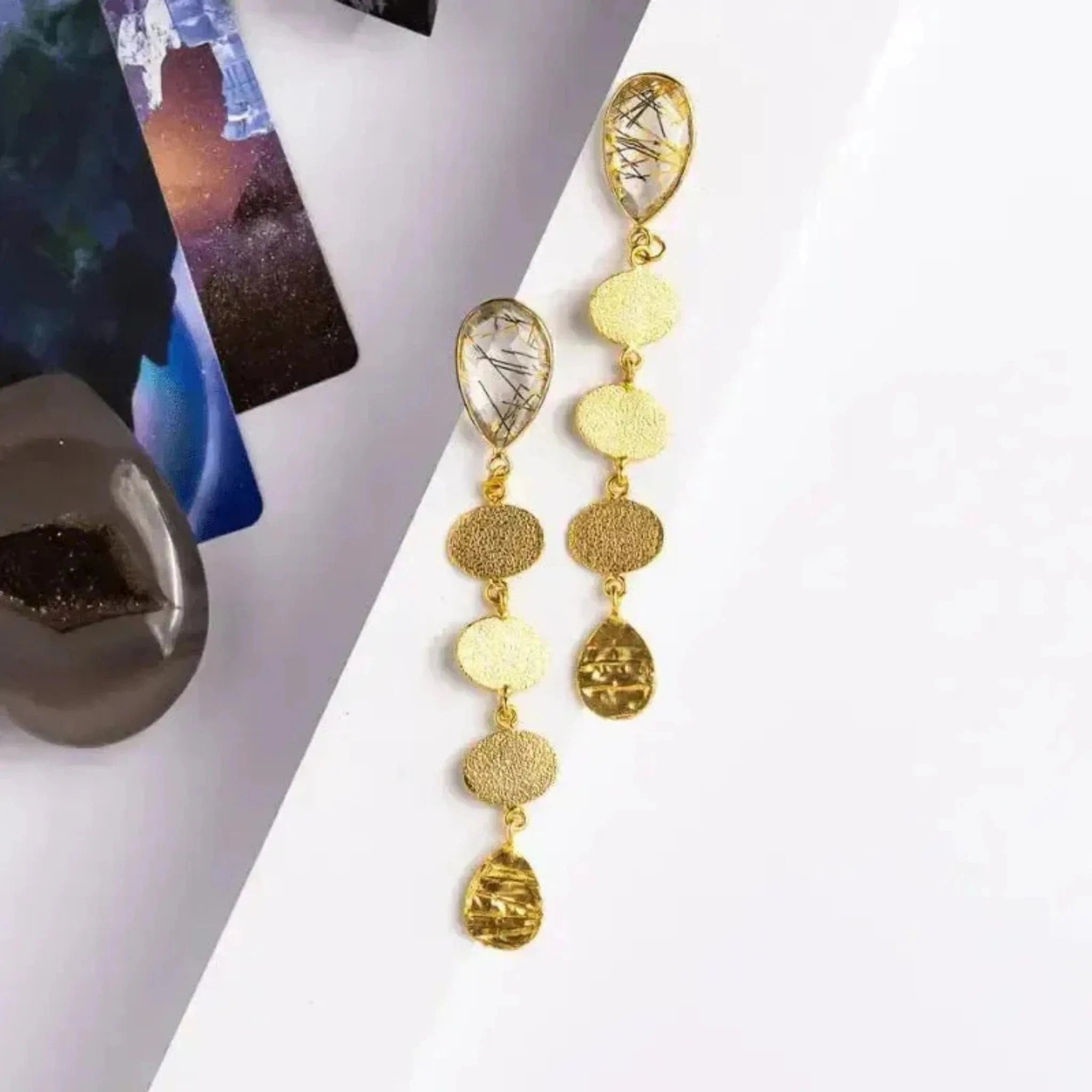

Type: earrings
Statement Rutile Quartz Earrings | Brushed Gold Disc Drops


Type: earrings
Pink Rutilated Quartz Statement Earrings | Triple-Link Gold Drop

Type: necklaces
Black Rutilated Quartz Gemstone Necklace | Grounding Clarity & Protection


Type: necklaces
Rutilated Quartz Silver Necklace | Lab-Created Stone, Modern Edge


Type: necklaces
Golden Rutile Chain Necklace | Solar Clarity & Calm Focus
Why I keep coming back to this stone
Clear quartz with needles running straight through it — gold like caught sunlight, black like lightning that got trapped before it could leave, pink like something quietly blushing. Same stone, three completely different moods. I have never once managed to pick a favourite.
The needles are rutile, a titanium mineral that grows inside the quartz while the quartz is forming. They aren't cracks and they aren't flaws, though people new to the stone often assume they are. They're the entire point. A piece with dense, chaotic webbing is more sought-after than a clean one — the opposite of how almost every other gemstone is valued.
Gold, black and pink — which to pick
Gold rutile is the classic and the warmest. Fine golden threads against clear quartz, associated with clarity, drive and manifestation. It reads richest against gold plate. The one most people start with.
Black rutile — often black tourmaline needles rather than rutile proper — is graphic and stark. Sharper lines, more contrast, more protective in feel. Sterling silver suits it best.
Pink rutile is the rarest of the three and the softest. Rose-toned needles, usually in a quartz with a faint blush, and it sits closer to self-compassion than to drive.
Lab-created and natural — both, on purpose
Lab-grown rutilated quartz is real quartz with real rutile, grown under controlled conditions. It produces the dense, dramatic webbing that mined rough rarely hands you twice, and it is considerably kinder on price.
Natural rutilated quartz comes up out of the ground with its own patterning and no two pieces ever match. It's less predictable and that's most of its appeal.
Neither is the lesser stone. Every listing states clearly which you're getting, because you should never have to guess what's sitting on your skin.
What it's worn for
Manifestation, mainly — the threads read as intention made visible, which is a fairly on-the-nose metaphor and none the worse for it. Gold rutile for drive and focus. Black for protection and boundary-setting. Clear quartz amplifies whatever it's near, so rutilated quartz tends to intensify the rest of a stack rather than sit quietly in it.
Wearing and caring for it
Quartz sits at 7 on the Mohs scale, so it's durable enough for daily wear. The needles don't weaken it. What it doesn't like is a hard knock on a faceted edge, and it doesn't like ultrasonic cleaners.
Warm water, mild soap, soft cloth, dry it properly. More in the crystal care guide.
Different stone, same standard: browse the full gemstone collection.
Questions people actually ask
Are the needles cracks or damage?
No. They're rutile crystals that grew inside the quartz as it formed. Denser webbing is more desirable, not less — which is backwards from how most gemstones are graded, and catches people out.
What's the difference between gold, black and pink rutile?
Gold is warm and associated with drive and clarity. Black is graphic and protective — often tourmaline needles rather than true rutile. Pink is the rarest and the softest in feel.
Is the lab-created version a fake?
No. It's real quartz with real rutile, grown rather than mined. It gives you denser, more dramatic webbing at a better price. Every listing states which you're buying.
Will two pieces look the same?
Natural pieces, never — the patterning is unique to each stone. Lab-grown is more consistent, which is exactly why some people prefer it.
Can I wear it every day?
Yes. Quartz is hard enough for daily wear and the needles don't weaken it. Avoid hard knocks on faceted edges and skip the ultrasonic cleaner.
What is rutilated quartz used for?
Traditionally manifestation, focus and clarity — gold rutile especially. Worn as a reminder of what you're working toward, not as a treatment for anything.