

Four places most people start:


Shop evil eye jewelry Shop the gift guide
There's a reason the evil eye has outlasted every trend, every era, every civilization that wore it. It speaks to something true: sometimes you need a little armour. Not the heavy kind. Just a quiet, steady reminder that your energy is yours to keep.
You know the moment. The reunion where one person always asks what you're doing these days, in that tone. The good news you hesitate to share because you know exactly who'll sour it. The evil eye is for walking into those rooms anyway.
I've been drawn to this symbol for years. There's something grounding about wearing a piece that people across history have worn for the same reason. Protection. Boundaries. A wearable "not today" to energy that doesn't belong to you. It's one of the symbols in the sacred symbols guide.

What the Evil Eye Means
The evil eye is a protection talisman, one of the oldest humans have made. It stands for a shield against envy, ill will, and the low-level negativity that collects when you're visible, successful, or simply having a good day around the wrong people.
It works on two levels. First, it deflects: the eye sees the harmful glance before it lands and turns it back. Second, it reminds: every time you catch it on your wrist or at your neck, you remember you get to decide what energy you carry. That quiet daily cue is underestimated.
In jewelry, the evil eye isn't about fear. It's about ownership of your own peace. A standing "no thank you" to energy that isn't yours.
Where the Evil Eye Comes From
The belief that envy can travel through a look is one of the most widespread ideas people have ever held, and the talismans against it go back thousands of years around the Mediterranean and the Middle East.
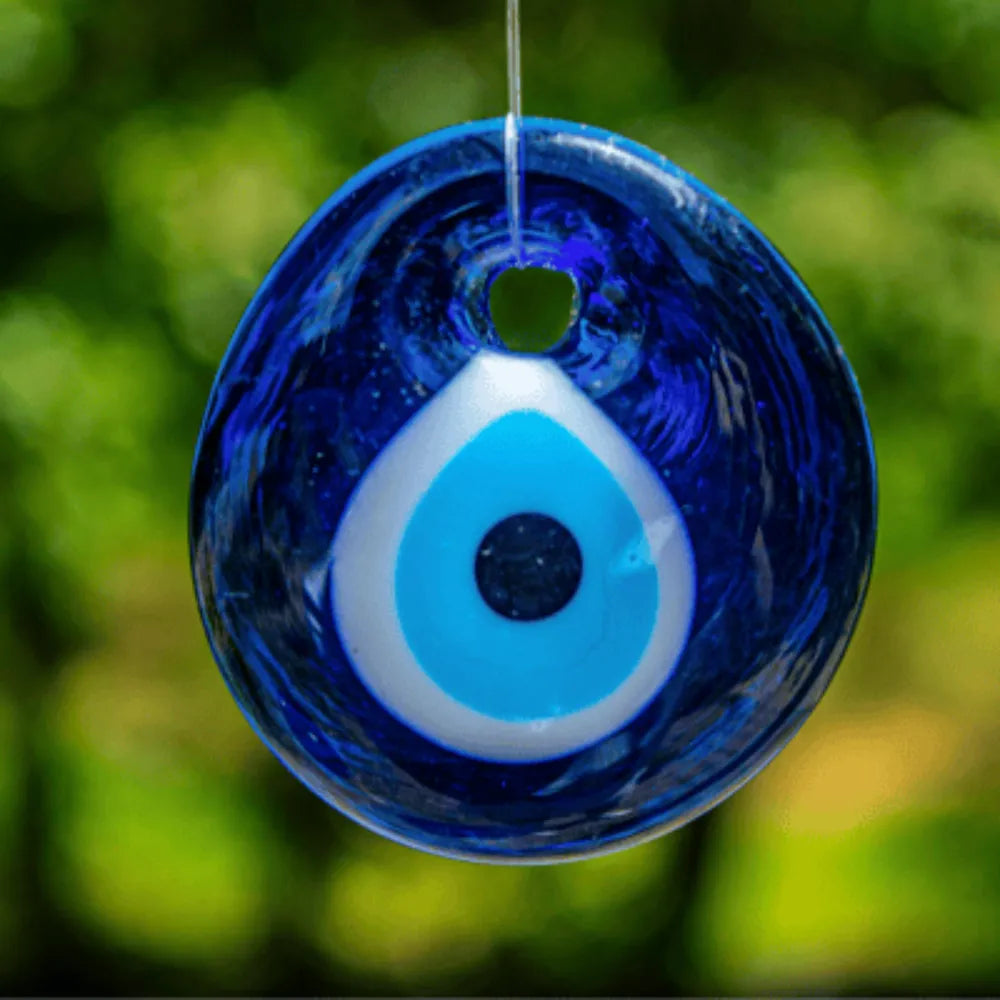
- Greece and Turkey: the blue glass eye is called the mati in Greek and the nazar in Turkish. It hangs in homes, cars and doorways, and around necks.
- The Middle East and North Africa: protective eyes guard the moments when attention follows you: newborns, new homes, new ventures.
- Jewish tradition: ayin hara, the evil eye, appears throughout rabbinic writing as something to name and guard against.
The hamsa hand grew out of the same instinct in overlapping regions, and the two are often worn together, sometimes as a single piece.
The common mix-up: the evil eye is not the third eye. The evil eye is outward, a talisman that guards what comes at you. The third eye is inward, the intuition you open. One says "what doesn't belong to me, I return." The other says "I can see clearly enough to know the difference." I often wear both at once.
What Each Colour Means
- Deep cobalt blue: the classic nazar colour, and the traditional choice for protection.
- Light blue: calm and peace.
- Black: grounding, for when you need to stay put.
- Gold: good fortune alongside protection.
In practice, choose the colour that looks like what you need. There's no wrong answer.
How to Wear the Evil Eye
The piece you're drawn to is usually the right one. If you want a starting point:
- Earrings. The Evil Eye Protection Stud Earrings are light, minimal and the easiest gift. For real sterling, the 925 Sterling Silver Evil Eye Studs.
- Bracelet. Visible to you all day, which strengthens the reminder. I reach for mine when I'm walking into a meeting with mixed feelings. Start with the Evil Eye Bracelet, or go stone-first with the Evil Eye Stretch Bracelet in eight natural stones.
- Ring. Subtle protection you'll catch every time you look at your hands. The Evil Eye Ring is a resizable blue CZ signet in gold or silver.
- Necklace. Keeps the symbol close to your heart. The Blue Evil Eye Set comes as a necklace, earrings, bracelet or all three. The Evil Eye & Third Eye Medallion lets you choose your eye.
If it's your first one, start at the easy end. A stud or a bracelet carries the same symbol as anything else here, costs a fraction of it, and you'll wear it every day, which is the part that does the work. Nobody should have to think hard about their first protection piece.
Deciding where a pendant should sit? Necklace length covers what each length lands on.


Stones That Pair With the Evil Eye
The evil eye is a symbolic shield; crystals are the anchor. Together they make a layered practice: the symbol for intention, the stone for grounding.
- Black tourmaline is the most direct pairing, carried as a protection stone for centuries. Think of it as doubling down on boundaries.
- Labradorite is my personal favourite here. It's the shielding stone for empaths and anyone who soaks up the mood of the room.
- Clear quartz amplifies whatever intention you've set.
- Blue stones like aquamarine and blue lace agate echo the traditional nazar blue and carry calm communication.
Every stone named here has a full entry in the crystal properties guide. Everything protective lives together in protection jewelry.
A 60-Second Protection Ritual
I'm not here to give you a 47-step ritual that needs a special moon and three kinds of incense. This one takes a minute.
- Put it on with one word. Before you fasten it, choose one: protected, clear, calm, steady. That's it.
- The reset touch. When your energy gets pulled, touch the piece and take three slow breaths. You're coming back to yourself.
- Monthly refresh. Clean it gently with the jewelry cleaning guide and ask what you need protection from right now. Name it specifically.
And if you want words: "My energy is mine to choose and mine to keep."
The Evil Eye as a Gift
The nazar has long been given at thresholds: a new baby, a new home, a new business. It still works that way. For a daughter's first apartment, a friend opening her own shop, the colleague who just got the promotion everyone's talking about. It says go do the brave thing, I've got your back. More ideas by meaning are in the gift guide.
Not sure which stone is for the chapter you're in?
The Gemstone Quiz takes 60 seconds.
Take the Gemstone Quiz →
Evil Eye FAQ
What does the evil eye protect against?
Envy, ill will and unwanted attention, especially the kind that comes with being visible or doing well. Traditions describe it differently, but they share one idea: a focused, envious look can do harm, and a talisman can turn it back.
What colour evil eye is for protection?
Deep cobalt blue is the classic protection colour, from the Greek and Turkish nazar tradition. Light blue is for calm, black for grounding, gold for good fortune alongside protection.
Can I wear an evil eye every day?
Yes, and that's the point. The talisman works through steady presence: you see it, you remember your intention, you come back to yourself. Each listing names its metal and whether it's waterproof, so check the piece you choose.
What happens when evil eye jewelry breaks?
In Greek, Turkish and Middle Eastern tradition, a broken evil eye did its job. It took the hit meant for you. Thank it, let it go respectfully, and replace it with a fresh one and a new intention. If the spiritual framing isn't your thing, a broken piece just means it's time for a new one.
Is it okay to buy an evil eye for yourself?
Yes. Some families hold that it's luckier as a gift, but buying your own is common everywhere the nazar is worn. Protection doesn't need a permission slip.
What's the least expensive way to start?
A pair of studs or a simple bracelet. The symbol doesn't scale with price, and the piece you wear daily does more than the one saved for occasions.
Keep Reading
Mystic Soul Jewelry — Canadian small business, Calgary, Alberta, since 2008.
Want the next symbol guide in your inbox when it goes up? The prayer wheel is next. Join The Circle. It's my list, it's free, and 15% off your first order and the Birthday Club come with it.
— Andrea


