

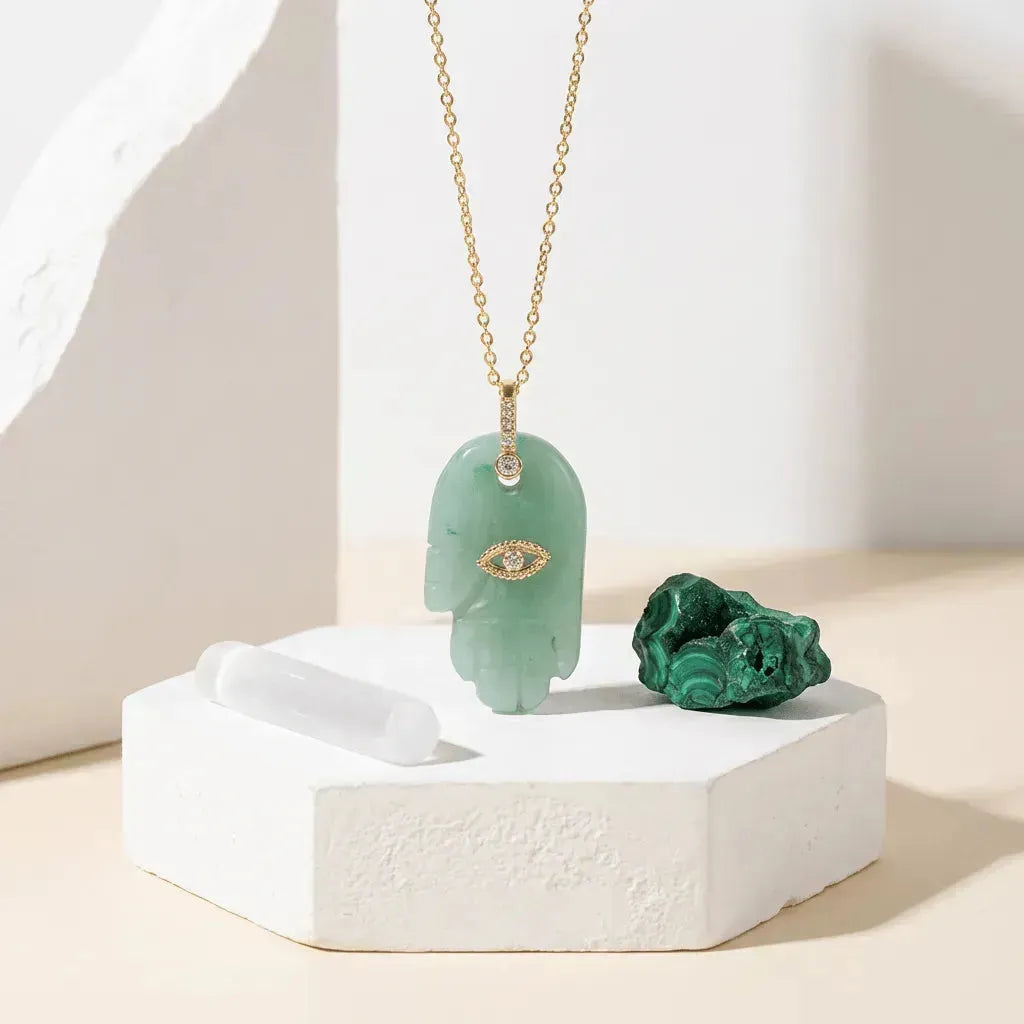
Four places most people start:
 Hamsa Hand Protection Ring$25
 Hamsa Hand Earrings$35
 Hamsa Hand Necklace$45
 Sterling Silver Hamsa Pendant$58
Shop hamsa jewelry Shop the gift guide
Five fingers. Palm facing out. The hamsa hand is one of the most widely recognized protective symbols in human history, and it has been doing this particular job for at least two thousand years.
It's the gesture you make without thinking when someone starts a sentence you don't want finished. Hand up, palm out: stop right there. The hamsa is that gesture, made permanent and worn close.
Also called the Hand of Fatima or the Hand of Miriam, it turns up across North Africa and the Middle East, in Jewish and Islamic practice alike. Here's what it is, where it came from, why it so often carries an evil eye, and how to wear it with the intention it was made for. It's one of the symbols in the sacred symbols guide.

What the Hamsa Hand Means
The word comes from the Arabic khamsa and the Hebrew hamesh, both meaning five, for the five fingers. The hand is stylized and symmetrical in a way no real hand is: the two outer fingers mirror each other, so it reads as intentional rather than anatomical. Many versions carry an eye in the palm.
Across its traditions, the hamsa is a protective amulet, worn or hung to turn away envy, ill will and harm. The outward palm is a stopping gesture: this far and no further. In many traditions it doubles as a blessing. The same hand that turns harm away can extend grace.
Where the Hamsa Comes From
Hand-shaped protective amulets are far older than either of the faiths that carry the hamsa most visibly today. Raised-hand symbols appear in the ancient Near East and in Phoenician and Carthaginian North Africa, where the hand is often linked with the goddess Tanit. Historians debate exactly how those early hands connect to the hamsa, but the instinct is the same.
- Jewish tradition: the five fingers are linked with the five books of the Torah, and the symbol is sometimes called the Hand of Miriam, after the sister of Moses.
- Islamic tradition: it's known as the Hand of Fatima, after Fatima Zahra, daughter of the Prophet Muhammad, revered in both Sunni and Shia Islam for purity and grace.
Across North Africa, the Levant and the Middle East it remains one of the most common protective symbols in daily life, on jewelry, doorways, walls and in cars.
A note on wearing the Hand of Fatima: the symbol carries real religious meaning in Islamic tradition, and in Jewish tradition too. It has always been shared across cultures, which is part of its story. Wearing it with awareness of where it comes from is wearing it well.

Up or Down? The Common Mix-Up
The most common hamsa question: which way should the fingers point?
Fingers up, palm out, is the active protective gesture: stopping what's coming. Fingers down is more often read as receiving: good fortune, abundance, blessing flowing in. Most protective hamsa jewelry points up. If protection is why you're wearing it, that's your orientation. If you're in a season of wanting more to come in, down works too.
The Hamsa and the Evil Eye
They turn up together so often it can look decorative. It isn't. The evil eye, ayin hara in Hebrew and nazar in Turkish, is the belief that envy can travel through a look. The hamsa is one of the oldest tools for stopping it. The palm blocks; the eye in the centre sees what's coming and turns it back. A wall and a watcher in one piece.
The evil eye has its own long story. The evil eye guide covers it.

The Hamsa Medallion Necklace: the symbol set into a solid disc, so it reads as jewelry first and talisman second.
How to Wear the Hamsa Hand
Start where it's easy. If this is your first hamsa, skip the statement piece. A simple ring or pendant carries the identical symbol, and because you'll wear it daily, it does more of the work than something saved for occasions. I'm deliberately building out the easy-entry end of this collection for that reason. The first protective piece shouldn't be a decision you sleep on.
Ring
The Hamsa Hand Protection Ring is the most-worn version: waterproof, gold plated, adjustable, and quietly there on your finger as a reminder to hold your own energy. For real sterling, the Hand of Fatima Ring is an open adjustable band with a zircon centre. What a ring on each finger means helps you pick the finger.
Necklace
A hamsa at the chest carries the protective intention toward the heart.
- The Hamsa Hand Necklace is the easiest place to start: five gold plated medallions, from a quiet 12 mm hand with a crystal centre to a 25 mm rectangular tablet, on the chain length you choose.
- The Sterling Silver Hamsa Pendant and the Blue Hamsa Pendant bring in the evil eye blue, in 925 silver.
- The Amazonite Hamsa Pendant pairs the hand with a throat chakra stone: truth-telling and the courage to hold your boundaries out loud. Protection and voice in one piece, for a season that needs both.
- The Fair Trade Brass Hamsa Necklace is cut from solid brass by artisans in Bali, openwork so light passes through. Roughly the width of a nickel. This one is meant to be seen.

Shorter chains, 41 cm / 16 in to 46 cm / 18 in, keep the hand at the collarbone. Longer, 51 cm / 20 in and up, lets it rest over the heart. Necklace length covers where each one lands.
Earrings
Earrings put the hand right beside your face, which is either deeply symbolic or simply where earrings go. The Hamsa Hand Earrings come in two small styles, hammered with an eye or crystal-centred, in gold or silver plated, on leverbacks that stay put. They match the charms on the Hamsa Hand Necklace if you want the pair.
Done for you
The Protection Set puts a hamsa necklace with black tourmaline earrings and a bracelet.

Stones That Pair With the Hamsa
- Amazonite for voice: the boundary you say out loud.
- Labradorite for shielding, the stone version of what the hand does.
- Black tourmaline for grounding protection.
- Blue lace agate and aquamarine to echo the evil eye blue.
The crystal properties guide has every stone named here. Everything protective sits together in protection jewelry.
The Hamsa as a Gift
The hamsa is the gift for someone stepping into exposure. A daughter's first job. A friend's new house. Your sister the week the divorce is final and everyone has an opinion. It says I can't stand between you and all of it, so here's a hand that will. More ideas by meaning are in the gift guide.
Not sure which stone is for the chapter you're in?
The Gemstone Quiz takes 60 seconds.
Take the Gemstone Quiz →
Hamsa Hand FAQ
What does the hamsa hand mean?
Protection. The palm-out hand is a gesture of stopping harm, worn to turn away envy and ill will, and in many traditions to extend blessing too.
What is the difference between the hamsa and the Hand of Fatima?
They're the same symbol. Hamsa comes from the Arabic and Hebrew words for five. Hand of Fatima is the Islamic name, after Fatima Zahra; Hand of Miriam is a Jewish name.
Does the hamsa point up or down?
Both are worn with meaning. Fingers up is the protective, stopping gesture. Fingers down is read as receiving good fortune. Most protective hamsa jewelry points up.
What does the eye inside the hamsa mean?
It's usually an evil eye: it sees envy coming and turns it back while the hand blocks. The evil eye guide has more.
Can anyone wear a hamsa hand?
Yes. It has been shared across cultures for as long as it has existed. Wearing it with awareness of its meaning in Jewish and Islamic tradition is the respectful way to do it.
How do I care for hamsa jewelry?
The gold ring is waterproof. Sterling silver likes to be worn and polished gently; plated and brass pieces stay away from water, lotion and perfume. I walk through how to clean sterling silver and brass step by step.
A symbol that has lasted thousands of years across dozens of cultures earns a certain amount of trust. The hamsa has been doing its job longer than most of the countries it appears in have existed.
Keep Reading
- The sacred symbols guide — every symbol, side by side
- Evil Eye Meaning
- Protection Jewelry: What to Wear When You Need a Boundary
Mystic Soul Jewelry — Canadian small business, Calgary, Alberta, since 2008.
Want the next symbol guide in your inbox when it goes up? The prayer wheel is next. Join The Circle. It's my list, it's free, and 15% off your first order and the Birthday Club come with it.
— Andrea


