

 Capri Cleo Earrings · glass$35
 Cleo Pyramid Necklace · glass$45
 Labradorite Bracelet · stone$45
 Amethyst Oval Studs · stone$65
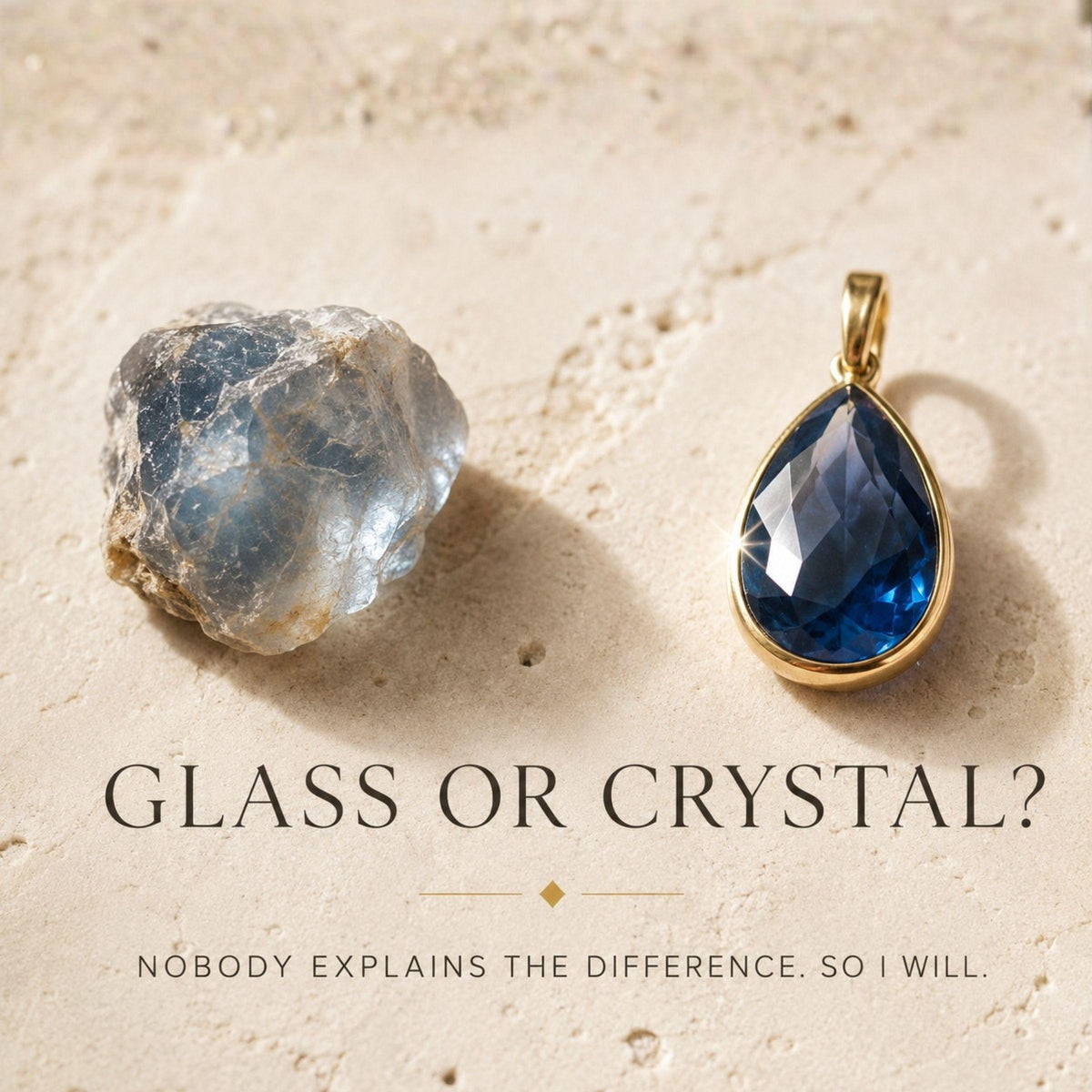
Somebody asked me this at a market years ago, and she asked it the way people ask when they think it's a stupid question. Head tilted down slightly. Voice lowered. Sorry, is this a real stone or is it glass?
It is not a stupid question. It is one of the best questions you can ask me, and almost nobody in this industry answers it straight.
So here it is, straight.

Four things people call crystal. Only one of them came out of the ground.
Glass vs crystal: neither one is the "real" one
This is the part that trips everyone up, because the question is usually phrased as is it real — which assumes one of them is the genuine article and the other is a stand-in for it.
They're two different materials. They do two different jobs. I use both on purpose, and I've never once thought of the glass as a compromise.
What you're choosing between is a stone that was found and a material that was made. Once you see it that way, the whole question gets easier, and so does deciding what you want.
What is a natural crystal? It came out of the ground
A natural crystal formed over a very long time, under pressure, in a specific place on earth. Nobody designed it. It came out how it came out.
Which means it carries evidence of that. Look closely at a natural stone and you'll usually find:
- Inclusions — tiny internal marks, fractures, mineral threads, sometimes a whole other mineral trapped inside
- Cloudiness — areas where light doesn't pass cleanly through
- Colour variation — a band that's darker at one end, a patch that's almost clear
- Temperature — stone stays cool against skin longer than most materials
- No two alike — not as a marketing line, just as a fact of how it was made
The part I want you to keep: those aren't flaws. A cloudy patch in an amethyst is not a defect that slipped past quality control. It's the record of how that stone formed. If you want a piece that is a specific thing from a specific place, the inclusions are the proof.
I've had people apologise to me for choosing the "less clear" one out of a tray. Don't. You chose the one with the most story in it.
What is glass jewelry? Made by a person
Glass is manufactured. Silica, heat, and a colourant, cut and polished into a shape someone decided on.

Smoky grey, cut clean. The colour is the same in every facet — no banding, no cloud. Somebody made it that way on purpose. Cleo Pyramid Necklace · Dusk Cleo Earrings
That sounds less romantic until you understand what it buys you.
- Colours the earth doesn't do. The Capri blue I use is not a colour you'll find in a natural stone. Not a close cousin of it — it doesn't exist naturally at that saturation.
- Clean cuts. Glass takes a sharp, precise facet without the internal structure of a natural stone deciding otherwise.
- Flash. Those facets throw light hard. If you want a piece that catches the room, that's glass.
- Consistency. The one you order looks like the one in the photo, and like the one your friend bought last year.
That last point matters more than people expect. If you're buying a pair of earrings, you want them to match each other. Natural stone won't guarantee that. Glass will.
Crystal is chosen. Glass is designed.
That's the shortest version I've got.
When I work with natural stone, I'm selecting — going through what exists and picking the one that's right. When I work with glass, I'm specifying — deciding on a colour and a cut and getting exactly that.
Both are design. They're just different halves of the job.
Hang on — what about Granny's good crystal?
Right. This is where the whole thing falls apart for most people, and it isn't your fault.

This is crystal. It is also, definitively, glass. Both of those are true and nobody ever explained it.
The decanter in your grandmother's china cabinet. The wine glasses that only came out at Christmas. The heavy tumblers that rang when you flicked them. Everyone called that crystal, and it was not a stone.
It was glass. Specifically, glass with lead oxide added to it — which makes it heavier, softer to cut, and much better at bending light. That's why cut crystal throws rainbows across a tablecloth when nothing else on the table does. The lead is doing that.
So the word crystal is carrying two completely different jobs in the English language:
- Crystal, the mineral. Amethyst, quartz, labradorite. Came out of the ground.
- Crystal, the glassware. Leaded glass, cut for sparkle. Came out of a factory in Waterford or Bohemia.
Same word. Nothing else in common. And nobody ever sat you down and explained it, so you've been carrying a quiet assumption that one of them must be the imposter.
Neither is. They were both correctly named, in different centuries, by different trades.
Is Swarovski crystal real?
Swarovski is the most famous name in that second category — and it's the one that confuses people most, because it sits on jewelry rather than a dinner table.
Swarovski is precision-cut glass. An Austrian company, going since the 1890s, built on a machine that could cut glass more precisely than anyone was doing by hand. That's the whole innovation, and it's a great one. What you're paying for is the cut — the consistency of the facets and the way that consistency throws light. (For years that glass was leaded like Granny's decanter. Since 2012 they've made it lead-free. Still glass, still cut beautifully.)
It is not a gemstone. It has never claimed to be. It's the very high end of what I described in the glass section: manufactured material, engineered colour, exceptional cutting.
People sometimes say "oh, it's only Swarovski" and I always want to push back on that. There's no only about it. It's a hundred-and-thirty-year-old company doing one thing extremely well. It's just a different thing from a stone that formed in the ground, and the confusion only exists because the word crystal got borrowed.
So if you inherited a Swarovski piece and you've been wondering whether it's "real" — it's real. It's real cut glass, made by people who are very good at cutting glass. That's what it always was.
What about lab-created stones?
This is where it gets confusing, and it's the question underneath the question for a lot of people.
A lab-created gemstone is not glass. It's the same mineral as its mined counterpart — same chemistry, same crystal structure — grown in controlled conditions instead of in the ground. A lab-created sapphire is sapphire. It will scratch what a mined sapphire scratches.
So we're now up to four things people all call "crystal" at some point: mined stone, lab-grown stone, leaded glassware, and plain glass. They're distinct, and blurring them together is the most common mistake I see careful shoppers make.
I wrote that one up separately because it deserves its own space — how lab-created gemstones are made and why they aren't "just glass".
One more thing that isn't what it sounds like: "aura"
For a while I called some of my lab-grown pieces Aura — Peacock, Tropical, Pink. That name confused people, fairly, so I've retired it from the listings. You'll see them now as what they are: hydro quartz, lab-grown quartz with the colour infused while the crystal grows. The Peacock Ombré pieces take two colours during growth, and they melt into each other — that ombré is why I reached for the word aura in the first place.
True aura quartz is a different thing entirely. It starts as natural clear quartz, which is then bonded with a vaporised metal — titanium, gold or niobium, usually — inside a vacuum chamber. The metal fuses to the surface and gives that oil-slick, rainbow shimmer. Natural quartz, treated finish. Mine is grown colour, all the way through.
I keep the two clearly apart, because I'd rather you know exactly what's in your hand than be charmed by a word.
What drives the price of crystal vs glass jewelry
Not the category. This surprises people.
A high-grade transparent natural stone costs a great deal because transparent, faceting-grade material is rare. But plenty of the natural stones I carry are opaque grade — real, earth-formed, same mineral, just not see-through. Denser colour, no facets, a fraction of the price.
That's not a lesser stone. It's a different grade of the same stone, and grade is what you're paying for, not authenticity. A genuine opaque ruby is a genuine ruby. It's a smart buy, not a compromise.
Meanwhile a well-cut piece of glass in a colour that doesn't exist in nature might cost less than either — and be exactly the right piece for what you wanted.
Price tells you about rarity and labour. It doesn't tell you what's real.
How to tell glass from crystal in your hand

Hold them to the light. The labradorite shows its flash and its marks. The glass shows one even grey, all the way through. Labradorite Oval Studs · Dusk Cleo Earrings
Nothing here is definitive on its own, but together they'll get you most of the way:
- Look for bubbles. Tiny round bubbles inside almost always mean glass. Natural stone gets angular inclusions, not spheres.
- Check the temperature. Hold it against your wrist. Stone stays cool longer.
- Feel the weight. Leaded glass is noticeably heavy for its size — that's the same principle as Granny's decanter.
- Look for a seam. Moulded glass sometimes shows a faint line. Cut stone never does.
- Compare two of them. If a pair is truly identical down to the internal detail, that's a manufactured material.
- Look at the colour edges. Natural colour usually shifts and bands across a stone. Manufactured colour is even all the way through.
And the simplest one: ask. Any seller worth buying from will tell you without getting defensive about it.
What I promise you
I won't sell you glass and call it a gemstone.
Every listing in my shop says exactly what the material is. If it's glass it says glass. If it's lab-grown hydro quartz it says that, in those words. If it's an opaque-grade natural stone I explain what that means rather than letting you assume it's something it isn't.
I do that because the alternative — letting a vague word do the work — is how people end up feeling foolish about something they loved. I've watched it happen. It's not worth a sale.
So which one should you buy?

Grey glass at the ear, grey stone at the wrist. Same colour family, two materials, two different jobs. Dusk Cleo Earrings · Labradorite Faceted Bracelet
Ask yourself what you want the piece to do.
Buy the crystal if you want a specific stone with a specific meaning, if you like that it came out of the ground, if you want something no one else has, and if a cloudy patch reads to you as character rather than a fault. Start with a labradorite bracelet — tilt it and the flash shows you what a stone does that glass can't — or browse gemstone jewelry by stone.
Buy the glass if you're after a particular colour, if you want flash and light, if you want a matched pair, or if you fell for a blue that doesn't exist in nature and you'd rather have the blue than the provenance. The Capri Cleo earrings are that blue, the Dusk Cleo are the quiet grey version, and every piece in Glass & Light is designed and assembled by me in Calgary.
Most of the women I sell to want both, often in the same week, for different reasons. That's not indecision. That's understanding what each one is for.
If you're not sure where to start with stones at all, my complete crystal guide is the place to begin — it walks through choosing a first stone without any of the mysticism-as-gatekeeping that makes this stuff feel closed off.
Still not sure what you want?
Take the Gemstone Quiz. It asks what's going on in your life rather than what colour you like, and it'll point you at a stone — or tell you that what you want is the glass, which is a perfectly good answer.
Glass vs crystal: questions I get asked
Is glass jewelry fake?
No. Glass is a real material made on purpose, and it does things natural stone can't — colours that don't occur in nature, sharp clean facets, pairs that match exactly. It's only "fake" if someone sells it to you as a gemstone.
Is Swarovski crystal a real crystal?
It's real precision-cut glass, not a mineral crystal. For most of its history it was leaded glass; since 2012 Swarovski has made it lead-free. Either way, you're paying for the cut, and the cut is excellent.
How can you tell glass from a natural crystal?
Look for round bubbles (glass) versus angular inclusions (stone), feel whether it stays cool on your wrist (stone does), and check whether a pair matches down to the internal detail (that's glass). When in doubt, ask the seller.
Is crystal glassware the same as a crystal gemstone?
No. Crystal glassware — Waterford, Bohemian, Granny's decanter — is leaded glass cut for sparkle. A crystal gemstone like amethyst or quartz is a mineral that formed in the earth. Same word, two different trades.
Are lab-created gemstones glass?
No. A lab-created stone has the same chemistry and crystal structure as the mined version; it was grown in controlled conditions instead of in the ground. Hydro quartz is lab-grown quartz, not glass.
Why is some natural stone jewelry so affordable?
Grade. Transparent, faceting-grade stone is rare and priced that way. Opaque-grade stone is the same mineral, just not see-through — real stone, honest grade, honest price.
Where to go from here
- The Complete Crystal Guide: Where to Start — the main guide, if stones are new to you
- Are Lab-Created Gemstones Real? — the third category, explained properly
- Glass & Light: The Sparkle That Doesn't Apologize — why I make the glass line at all
- Exquisite Jewelry Style Guide — choosing by colour rather than by material
- The Greek Island That Named a Colour — where the Capri blue came from
- How to Clean Glass and Crystal Jewelry — glass and stone need different care
Shop
- Glass & Light — the glass line, designed and assembled by me in Calgary
- Capri Blue — the colour the earth doesn't make
- Gemstone Jewelry — natural stone, browsable by stone
- Crystal Necklaces
- Earrings
And if you're standing in front of something of mine wondering which it is — just ask me. I'll tell you. It's the easiest question I get all day.
Join The Circle — 15% off your first order (good 7 days) + the Birthday Club.
Get the next guide in your inbox before it goes anywhere else.
Join The Circle here.
Mystic Soul Jewelry — Canadian small business, Calgary, Alberta, since 2008.


