

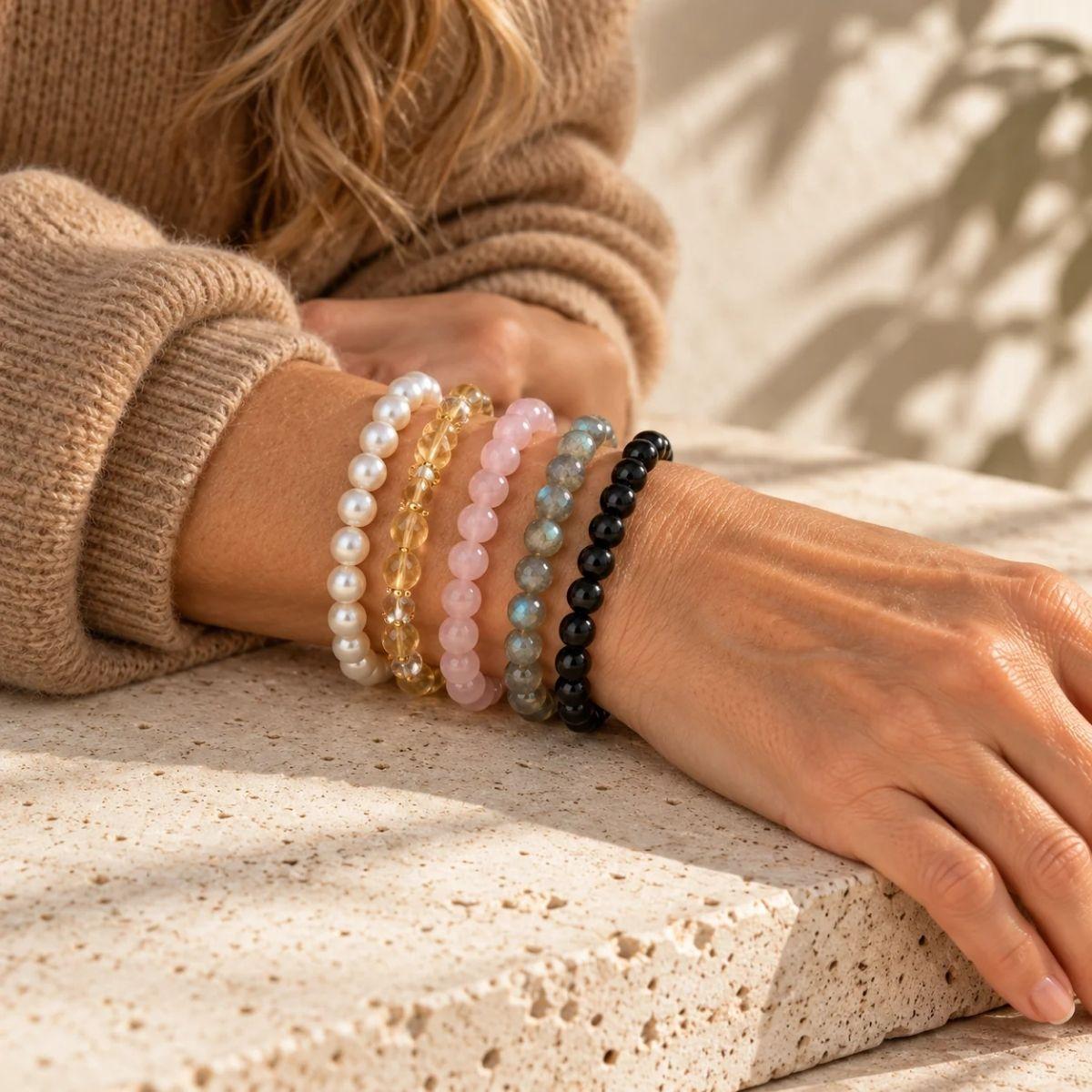
Quick Shop: Crystal Bracelet Stacks · Spiritual Bracelets · Gemstone Jewelry · Best Sellers
The easiest crystal bracelet you'll ever buy is your first. You see it. You feel it on your wrist. You know it's yours. Done.
The next four are the ones people ask me about.
How do I build a stack that isn't just five random things sharing a wrist? How do I make the whole thing mean something?
Some version of this lands in my inbox every week. The answer is simpler than I expected — the trick isn't buying more bracelets. It's knowing what each one is for.
Here's the five-piece framework I use for myself and recommend to clients. One role per bracelet. You don't need them all at once — most people build the stack over six to twelve months. But once the framework is in place, the stack builds itself.
This is one of seven guides in how to wear crystal jewelry — the full map of placement, length and layering.
Jump to:
- Why stacks work (when they work)
- The five-bracelet framework
- 1. The Anchor
- 2. The Mood
- 3. The Heart
- 4. The Protection
- 5. The Amplifier
- Styling rules (metals, order, size)
- How to care for a stack
- Bracelet stack FAQ
Why stacks work (when they work)
A bracelet stack isn't "more jewelry." A good stack is a portable kit — five small decisions that together hold a bigger one.
One bracelet carries one intention. A stack carries a day.
Mornings need grounding. Meetings need confidence. Evenings need softness. A well-built stack covers the range without you having to swap jewelry at lunch. You touch the one you need in the moment you need it.
The common mistake: buying five bracelets that do the same thing. Five for "good energy." Five in the same stone. That's a collection, not a stack. A stack has range.
Here's how to build that range — and where to start if you only have one bracelet so far.

The five-bracelet framework
Five bracelets. Five jobs. Any stone can fit any role — the framework is about intention, not species. Bead bracelets, faceted, cord, mixed. Doesn't matter.
The roles:
- The Anchor — your foundation. The intention you return to every single day.
- The Mood — the one that changes with what you're walking into.
- The Heart — relational or emotional. For love, compassion, connection.
- The Protection — the energetic filter. For draining weeks.
- The Amplifier — the universal booster. Usually clear quartz.
Build in this order: Anchor first. Then Mood. Then whichever of the remaining three feels most useful to your life right now. Most people don't need all five on day one. The stack grows into itself.
If you'd rather see the framework already assembled, the Crystal Bracelet Stacks collection is the shortcut — the bracelets I'd put together, in one place. It also runs Stack of 3: buy two, get one free, which is the sensible way to fill three roles at once instead of one at a time.
1. The Anchor
The piece you wear every day. The intention you always return to.

This is your foundation. The one you put on first, take off last, and wear even on days when you skip the rest of the stack. It carries the theme of the chapter you're in — the bigger thing you're working on across this year of your life.
Good picks depending on your current chapter:
- Labradorite — if you're in a transformation year. Big change, new job, end of something. One of my hero stones for a reason.
- Rose Quartz — if you're learning to receive, rest, or be gentler with yourself. Classic heart-center foundation.
- Amethyst — if your year is about calming the nervous system, sleep, or spiritual practice.
- Green Aventurine — if abundance and slow growth is the theme. Also one of my most-stocked hero stones.
- Black Tourmaline — if you're rebuilding boundaries or exiting a draining chapter.
Choose one. Wear it daily. You'll know within two weeks whether it's your anchor — the right one stops feeling like jewelry and starts feeling like something you own.
Look for 8mm bead bracelets — sturdy enough for daily wear, comfortable under sleeves.
→ Shop bracelet stacks to find your anchor
2. The Mood
The one that changes with the day.

The bracelet you swap depending on what's happening. Monday presentation? Confidence stone. Quiet Saturday? Soft stone. Full moon? Lunar stone. This is your most active piece — the one that participates in what you're doing that day.
You can build up to two or three options in this slot over time. Most people start with one and rotate.
- Citrine — for focus, creativity, presentation days, mental clarity.
- Tiger's Eye — for confidence, courage, high-stakes meetings, job interviews.
- Moonstone — for quiet days, intuition, emotional processing, moon phases.
- Blue Lace Agate — for communication, difficult conversations, writing days.
- Carnelian — for creative work, energy, days when you need to get moving.
The Mood piece is the one you'll probably collect variations of over time. That's fine. This is the slot designed for options.
→ Shop mood bracelets by stone
3. The Heart
A relational piece. For love, compassion, or connection.

Every good stack has a heart-chakra piece. This is the bracelet that holds your relationships — with others and with yourself. It doesn't have to be dramatic. It can be a small rose quartz bracelet you wear to remind yourself to be as kind to yourself as you are to other people.
Classic heart-chakra picks:
- Rose Quartz — the self-compassion standard. Also excellent for relationships you're actively tending. Rose Quartz Heart Chakra Bracelet — $28
- Green Aventurine — heart-center with a practical, abundance-coded edge. For people who want the heart work without the pink.
- Emerald — the most formal heart stone. Venus-coded. Good for committed love, whether to a partner or a practice. Full guide: Emerald and what it does.
- Rhodonite — for tending relational wounds, forgiveness, or processing heartbreak.
- Malachite — the heart stone with edges. For people who love fiercely and sometimes unevenly.
If you're skipping a role early on, this isn't the one to skip. The heart piece grounds the whole stack emotionally.
Not sure which stones are yours?
The free Gemstone Quiz takes two minutes and matches you to stones based on what you're walking through right now. Useful for picking your anchor.
4. The Protection
The energetic filter. For draining weeks and difficult environments.

If you work in a draining environment, take on other people's emotions easily, or spend time in places that feel heavy, the protection slot matters. This is the bracelet you reach for on days when everyone wants something from you.
Protection doesn't mean "nothing bad gets in." It means you notice sooner what isn't yours. That's the mechanism.
- Black Tourmaline — the classic. Absorbs and neutralizes. Good for empaths, caregivers, customer-facing roles. If you want it as a set, The Protection Set — $125 pairs the bracelet with earrings and a hamsa necklace.
- Obsidian — more intense. For periods when you need a stronger boundary. Not for daily wear.
- Hematite — grounding, reflective. Bounces energy back rather than absorbing it.
- Smoky Quartz — gentler protection. Good if black tourmaline feels like too much.
Rotate the protection piece — don't wear the same one for months on end. Energy-absorbing stones benefit from being set down and cleansed regularly. Between rotations, here's how to clean a crystal bracelet.
5. The Amplifier
The universal booster. Usually clear quartz.

The fifth piece pulls the whole stack together. Clear quartz is the standard because it amplifies whatever intentions you've set with the other four. Wearing clear quartz alongside your anchor makes the anchor louder. Alongside your heart piece, the heart piece works harder.
Clear quartz doesn't have its own agenda. It's the connector. Clear Quartz Crown Chakra Bracelet — $28
If clear quartz isn't your thing, two alternatives work:
- Selenite — lighter, lunar, more feminine-coded. (Water-sensitive — keep it dry.)
- Clear quartz with rainbow inclusions — same amplification, a little more visual interest.
The amplifier slot is usually the last one people fill because it doesn't feel as urgent as the anchor or the heart. Fill it anyway. The stack is noticeably more cohesive with it in place.
Styling rules (metals, order, size)
Once you have the five pieces — or three, or however far you've built — here's how to style them.
Mixing metals is fine
Old rule: match your metals. New rule: don't worry about it. Gold-accented bracelets stack beautifully with silver. The only thing to avoid: bracelets with clashing metal finishes touching directly (a shiny gold lobster clasp right up against a brushed silver one looks scrappy). Solve it by putting a bead bracelet between them.
Bead size creates the structure
A balanced stack usually has: one chunky bead (8mm), two medium (4–6mm), two dainty (2–3mm faceted). That mix gives visual interest without looking overloaded. Same size across all five and the stack reads flat. Too mixed in size and it reads chaotic.
Order doesn't matter metaphysically. Visually, it does.
Stones work regardless of position on your wrist. But for the look: chunky piece at the wrist bone, dainty pieces inward. Frames the stack and keeps the smaller pieces from disappearing.
Match one pair to your outfit
The finishing move. Pick one bracelet that nods to the color or metal of what you're wearing. The other four are wildcards. One anchor-to-outfit piece ties everything together.
Which wrist you stack also carries its own meaning — that's covered in left wrist or right.
If you want a styling framework that works across changing seasons, I covered it in how to dress your energy for the season shift.
And if you want the subtler office version of a stack, it's in 5 Ways to Wear Crystal Jewelry to Work — the watch-stack approach scales the framework down for professional settings.
The Gift Stack
A single bracelet is a hint. Three is a stack — and a stack turns out to be the easiest meaningful gift there is, because you don't have to get the stone right. You just have to give her range.

- 01 · The Anchor — the Freshwater Pearl Bracelet ($45). Genuine pearls that go with every sweater she owns.
- 02 · The Mood — the Faceted Citrine Dainty Bracelet (from $54). A little gold light for the shortest days of the year.
- 03 · The Protection — the Labradorite Faceted Bracelet ($45). The flash stone, for the woman who carries everyone else.
All three are in the Crystal Bracelet Stacks collection, which runs buy two, get the third free — applied at checkout, no code. So the third one is on me.
Sizing a bracelet you're giving
Wrap a soft tape measure — or a strip of paper you mark with a pen — just below the wrist bone, snug but not tight. For beads, add about 1.5 cm so the stack can move. If you can't measure her without giving away the surprise, borrow a bracelet she already wears and measure it laid flat. When in doubt, choose a stretch or adjustable style; every listing says which it is.
Stacking in sweater season
Knit cuffs and bead stacks have a long-running disagreement. Push the sleeve up and let the stack sit on bare skin, or let one fine chain bracelet ride over the cuff and keep the beads underneath. Either way, the stones stay where you'll see them.
How to care for a stack
A five-bracelet rotation lives longer than a single piece worn every day. But it needs a little structure.
Rotate, don't pile. Wear the full stack sometimes, a trimmed three-piece version other days. Stones and stretch cords both last longer when they're rested.
Take off before water, lotion, and sleep. Bead bracelets can be worn in the shower if you must, but every shower is a small erosion of the stretch cord and the stone surface. A small dish on your dresser, away from the bathroom, where the stack lives overnight — that's the move.
Clean gently. Soft damp cloth for beaded bracelets. Never ultrasonic. Never harsh chemicals. Here's how to clean beaded bracelets stone by stone — especially selenite and pyrite, which have specific sensitivities.
Replace stretch cord before it snaps. If your bead bracelet feels loose or the stretch is visible, it's time to restring. MSJ bracelets can be sent back for restringing — email me. Don't wait for the cord to break mid-meeting.
Store it dry and apart. Strung bracelets go brittle in dry winter air, which is why they seem to snap in February. Here's how to store a bracelet stack so the cords last.
A stack is a slow project. The Circle is built for slow.
It's my email list with a rewards program quietly attached. Free to join, and you start with 15% off your first piece — which is a reasonable way to begin a stack. Stay a while and it turns into free shipping on every order, early access to the one-of-a-kind bracelets before they go public, and a chakra reading written by me. No app. No points. No dashboard to log into.
Bracelet Stack FAQ
How many bracelets should be in a stack?
Three to five is the sweet spot. Five is the full framework — anchor, mood, heart, protection, amplifier. Three covers most days and keeps the wrist from feeling crowded. Below three isn't a stack, it's a pair. Above six and the stones start competing for attention.
Can I mix metal colors in a crystal bracelet stack?
Yes. Mixing gold and silver is modern and looks intentional. The only thing to avoid is two clashing metal clasps touching directly — separate them with a bead bracelet in between.
How do I choose my anchor bracelet?
Pick the stone whose meaning matches the chapter you're in this year. Transformation year? Labradorite. Rebuilding boundaries? Black tourmaline. Slow abundance? Aventurine. The anchor is about the year, not the day. If you're stuck, the Gemstone Quiz matches you in two minutes.
Is it okay to mix different stones in a stack?
That's the whole point. Five stones doing five different jobs is what makes a stack work. Five of the same stone is a collection. The framework is built around contrast — grounding stone next to softening stone next to amplifier.
Can I wear a crystal stack every day?
The anchor, yes. The full stack, no — rotate. Stones and stretch cords last longer with rest. Wear the full five sometimes, a trimmed three other days, just the anchor on quiet days. The rotation is part of the practice.
Does the order of bracelets in a stack matter?
Energetically, no. Stones work regardless of where they sit on your wrist. Visually, yes — chunky pieces at the wrist bone, dainty pieces inward. Frames the stack and keeps the smaller bracelets from disappearing.
How do I build a stack on a budget?
Start with one anchor and add over time. Most of my clients build the full five over six to twelve months. The anchor and the heart piece are the two to invest in first — the protection and amplifier slots can be filled later with simpler pieces. Two things help: the Crystal Bracelet Stacks collection runs a buy-two-get-one-free on threes, and joining the Moon Circle takes 15% off your first piece.
Ready to start building? The anchor is the only piece you need to decide on first — everything else grows from there. Browse the bracelet stacks, or join the Moon Circle and start with 15% off.
Keep exploring: How to Wear Crystal Jewelry · Crystal Bracelet Stacks · Gemstone Jewelry · Chakra Collection · Bracelet Placement Meaning · 5 Ways to Wear Crystals to Work
Designed in Calgary. Stacked thoughtfully.


