



Shop Prayer Wheel Jewelry The Gift Guide
Somewhere in the last few years, you stopped being able to say the thing.
Not all of it. You still order coffee and answer the phone and tell your daughter you love her. But there is one sentence — the one for the hospital room, or the graveside, or the brother who has decided in advance what you meant — and it will not come. You open your mouth and there is weather in there instead of language. You are not faithless. You are tired, and the words have stopped arriving on time.
A Tibetan prayer wheel makes a claim about exactly that. It is a cylinder holding a tightly wound scroll of mantra, and turning it is held to be the equivalent of reciting what is inside. Which means the practice says something that took me years to hear properly: the intention counts even when you haven't got the words. You don't have to produce a sentence to have meant something.

What a prayer wheel is, precisely
You have probably seen one. A hand wheel — a mani wheel — is a metal drum on a spindle with a weighted bead on the side, so a small flick of the wrist keeps it turning. Inside is a scroll, wound tight around the axis, printed with mantra repeated over and over down the length of the paper. The drum is a container. The mantra is the point.
They come in every scale: the one in your hand, the row set into a wall along a pilgrimage route that people brush with their fingertips as they pass, the tall ones in a temple that take a whole shoulder to move. Some are turned by water, some by wind. The wheel does not care whether the turning is grand.
The mantra on the scroll is most often om mani padme hum, the six-syllable mantra associated with Avalokiteshvara — Chenrezig in Tibetan — the bodhisattva of compassion. Word by word it renders as something like om, jewel, lotus, hum, which is why teachers in the tradition say the literal translation is the least useful thing about it. The syllables are held to carry compassion itself, not a sentence describing it.
And if you have read the om symbol guide, you already know the first syllable. It's one of the symbols in the sacred symbols guide, if you want to see the whole family.
Clockwise. This part matters.
Turn it clockwise. If you own one, or you are about to, this is the detail worth having.
Clockwise is the traditional direction, the same direction as circumambulation — the way a practitioner walks around a stupa or a shrine, keeping the sacred thing on their right. It also follows the way the mantra is written on the scroll, so turning clockwise runs the syllables forward rather than backward. There is no penalty being counted somewhere. It is simply the way the practice is done, and doing it the way it is done is most of what respect looks like from the outside.
Hold it so the drum sits upright, let the weight swing, and let your wrist make a small circle. It settles into a rhythm within about ten seconds — far closer to knitting than to ceremony.
The prayer you cannot say out loud
Here is the reason I wanted to write this one.
In 2020 my son was admitted to the children's hospital. He was seventeen. It was urgent enough that they got him onto a bed first and admitting came to us in the room — nobody had time for a desk and a clipboard. He was there a week while they ran tests and nobody could tell me what was wrong. Then emergency surgery. He had lost half his blood.
What they eventually found was a Meckel's diverticulum — a small leftover pouch in the small intestine that some people are simply born with. The doctors call it the rule of twos: roughly two percent of people have one, only about two percent of those ever have any trouble from it, and when there is trouble it usually turns up by age two. He was seventeen. We were well outside every two we had been given.
It was COVID, so I was one of only two people allowed in that room. Everyone who came through the door was in a full gown, gloves, mask, hair covered. Outside every room stood a cart with trays of PPE and a garbage bin beside it, and the sheer volume of waste those bins swallowed in a day is a thing I still think about. I had also just found out my husband was cheating, and had asked for a divorce.
My memory is bad — ask me what I did yesterday and I will guess. But I can see that hallway perfectly. They were pushing Harper's bed toward the elevator and into surgery, and the path was barely a path: carts down both sides, every single person covered head to foot so you could not read one face. We got to the end and had to turn the corner, and the bed would not go. And one of the orderlies, without missing a beat, said it.
“Pivot. Pivot. Pivot.”
Ross. In a hospital corridor, at the worst moment of my life, a stranger in full PPE handed me Friends. I have no idea what my face did. I have no idea what I said back. I only know that somebody found the one thing that could get a sound out of a mother who had run out of them.
Pivot. Turn. Keep going. I would not have put it that way at the time, but that is more or less the entire instruction printed on the object I was holding.
Because I do not know what I was praying in that room. I am not sure it had words in it. What I know is that I sat there and turned my prayer wheel ring for hours, day after day, until the little bead on the side flew off.
I needed it. It took a lot.
That is what a prayer wheel is built for. The mantra is already inside. Somebody wrote it generations before you, wound it tight and sealed it in, so your job is not to compose anything. Your job is to turn.
The turning is the prayer.
I am not Buddhist, and I do not follow any one philosophy. What I do is find objects of adornment and meaning fascinating, and I tend to learn them at the exact moment I need them. The symbol shows up. I live the lesson. Then somewhere down the road I start working with it, and the women who need that same thing find me. That has happened enough times now that I have stopped being surprised by it.
What a prayer wheel changes, and what it does not
Let me be careful about what I am and am not saying, because this is where spiritual jewelry gets slippery. Turning a wheel does not change an outcome, and I would not sell you a necklace on the promise that it might.
What it changes is the shape of the ask. There is no longer a right sentence to hunt for and fail to find at four in the morning. There is a small physical act you can do with a body that has nothing left in it, and a tradition that says that act is not a lesser version of prayer. It is prayer.
Why a prayer wheel lands harder at 55 than it would have at 30
By now you have sat with someone dying. You have had the conversation that went badly and could not be repaired by being more articulate. You know what it is to run out of words in the one room where words were all you had.
Wordlessness is not a beginner's problem. It arrives late, and it arrives with weight.
That is who a prayer wheel necklace is for.

Not sure which stone is for the chapter you're in?
The Gemstone Quiz takes 60 seconds.
Take the Quiz →
Is it yours to wear? The honest answer
I am not going to bury this one in the FAQ.
A prayer wheel is not a motif. It is a working object inside a living tradition — Tibetan Buddhism is practised today, by millions of people, and the wheel is not a relic of it. Somebody turned one this morning. That fact sits underneath any decision you make about wearing one.
What I have come to, and I hold it as my position rather than a ruling: wearing a prayer wheel respectfully means knowing what it holds and why it turns. The line is not about who your grandparents were. It is about whether you are borrowing something sacred with your eyes open, or wearing a shape because the shape is pretty.
In practice that is small and unglamorous. You know the mantra it carries is om mani padme hum and you know whose mantra it is. You turn it clockwise. You do not call it a fidget, hand it round as a novelty, or wear it as a costume for a meditation photo. If someone asks what it is, you tell them the true thing — that it is a Tibetan Buddhist prayer wheel, and here is what is inside it.
If after all that it still sits wrong with you, that instinct is worth listening to. The sacred symbols guide covers the rest of the family if you want the range first. Nobody is required to wear this one.
The three prayer wheel pieces, and how they differ
The three I'd point you to live together in the prayer wheel collection. And the thing most people expect to separate them does not.
Two of them turn. One does not — and that is the one I would have kept. The two stainless steel pieces are working drums on spindles with a hollow vessel inside, the same object at two sizes in two colours. The third is a handmade Tibetan piece in sterling silver that neither spins nor opens, and I will explain in a moment why I still put it first.
One honest note before you choose: the two that open arrive empty. There is no prayer scroll rolled up inside waiting for you. I would rather say that here than have you open the box looking for one — and as it turns out, the empty vessel is the better half of the story.
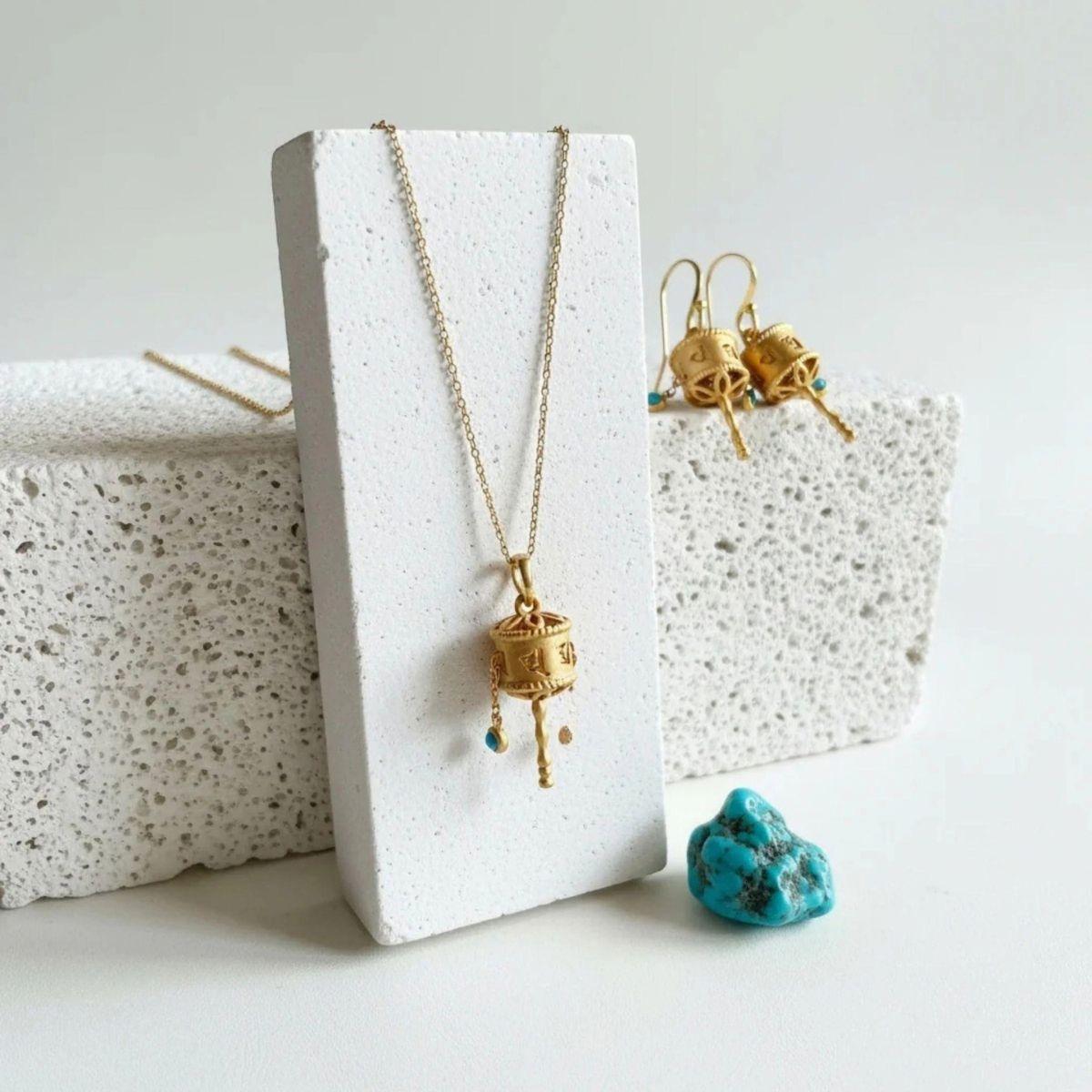
Tibetan Prayer Wheel Necklace & Earrings | Sterling Silver + 22k Gold
Sterling silver plated in 22k gold, chased and assembled by hand in Tibet. I bought these more than twelve years ago and they have been in my studio ever since. Sometimes it takes a while to be able to release something.
This is the one for detail. The wheel is 28 mm long and 12 mm across, 36 mm in total drop with the bail, and every bit of that surface was worked by a person rather than a mould. You can tell in about two seconds — cast metal is smooth in a way hand-chased metal never is. There is a small turquoise-coloured resin dot at the base, which is a resin dot and not natural turquoise, and I would rather you heard that from me than found it out later.
The thing it does not do is turn. This wheel is decorative and the pendant does not open, so if the practice is what you are after, take one of the two below. If what you want is the object itself — made properly, made where the practice lives, at a level of finish I cannot get from a factory — this is the one. It comes as the necklace, the earrings, or the pair, and there is exactly one of each. When they go, that is the end of it.
See the Tibetan Prayer Wheel necklace and earrings

Prayer Wheel Pendant Necklace | Mantra Locket with Hidden Vial
Gold-plated stainless steel, and the larger of the two spinning pieces. Working drum, working spindle, hollow vessel inside. If your everyday metal is gold and you want the mechanism rather than the handwork, this is your version — and it is the only gold-plated spinner I carry.
See the Mantra Locket with hidden vial
Prayer Wheel Necklace Mini | Stainless Steel Spinning Pendant
Silver-tone stainless steel, scaled down to sit under a collar. Same mechanism, smaller drum. This is the discreet one — you can turn it in a queue at the pharmacy without a single person noticing. If you want the practice more than the statement, take the mini.
See the Prayer Wheel Necklace Mini
What goes inside
In the two that open, the vessel arrives empty, which means the first decision is yours.
A written mantra, if you want the traditional one — om mani padme hum, copied out in your own handwriting. A name on a folded scrap of paper. One word you are trying to hold on to. A pinch of soil from a place that mattered. Whatever goes in stays between you and the pendant, and nobody is ever going to ask you to open it.
That is closer to the original logic than a factory-rolled scroll would be. A prayer wheel was never really about the drum. It was about what somebody wound up inside it and carried close.
The Tibetan set is solid, so it carries the shape of that idea rather than a scroll. The words are already in there in the sense that matters — somebody made the object knowing exactly what it was for.
A note on the metals, and how to look after them
The two spinners are stainless steel, one of them gold-plated, and that is deliberate rather than incidental. A spinning drum has a spindle, a housing and a bearing surface that has to sit loose enough to turn with one finger and tight enough not to rattle itself apart — and it has to open and close cleanly a thousand times, because a vessel that will not stay shut is not a vessel. Steel holds that tolerance better than a softer metal would. It also does not tarnish, and it takes a Calgary winter without complaint.
Sterling behaves differently. It will darken over time, which is not damage, and gold plate wants a soft dry cloth rather than a dip. My guide on how to clean sterling silver and gold plate covers both routines. For the steel spinners it is close to nothing at all: keep the mechanism dry, wipe it clean, do not soak it.
Living with one
Nobody needs a ritual with steps for this. That is rather the point of the object.

Give it a place in your day rather than a schedule — the first red light on the way to work, the moment you get into bed and your brain begins its nightly inventory. Turn it clockwise. Do not narrate. If a name comes, let it come. If nothing comes, that is the case the practice was designed for.
And when the words come back — because they generally do, on their own timetable and never the one you wanted — the months without them were not wasted. Something was being said the whole time. You were not the one saying it out loud, that is all.
Devotion is not a performance you can fail for lack of vocabulary. One of its oldest technologies is a cylinder, a scroll, and a wrist.
Shop Prayer Wheel Jewelry Shop Spiritual Symbols
Still deciding what to wear for the chapter you are in?
The Gemstone Quiz takes 60 seconds and gets you to a stone rather than a maybe.
Take the Gemstone Quiz →
If you would rather be pointed at a symbol than a stone, the Spirit Animal Quiz comes at it from the other direction.
Keep Reading
- The sacred symbols guide — every symbol, side by side
- The om symbol guide — the sound this mantra opens with
- The lotus symbol guide — the padme in the mantra
Prayer wheel questions people are asking
Q: Which way do you turn a prayer wheel?
A: Clockwise. It matches the way practitioners walk around a stupa or shrine, keeping the sacred object on the right, and it runs the mantra on the scroll forward rather than backward. If you catch yourself turning it the other way out of habit, just switch.
Q: Does a prayer wheel necklace really spin?
A: Two of my three do. Each of those is a drum on a spindle you can turn with a finger, and each opens to a hollow vessel inside — a larger gold-plated one and a silver mini. The handmade Tibetan sterling silver piece is decorative: the wheel is fixed and the pendant does not open. All three are in the prayer wheel collection.
Q: Does it come with a prayer scroll inside?
A: No. The two that open arrive empty — there is no mantra paper rolled up in the vessel, and I would rather tell you that up front. What goes in is yours to choose. The Tibetan set does not open at all, so nothing goes inside that one.
Q: Can I put my own mantra or intention inside one?
A: Yes, in the two stainless steel pieces. A written mantra, a name on a folded scrap of paper, or a pinch of soil from somewhere that matters will all fit, and what you put in stays between you and the pendant. The Tibetan piece is solid, so it holds the idea rather than the paper.
Q: Is it appropriation to wear a prayer wheel?
A: It depends on whether you know what you are wearing. A prayer wheel belongs to Tibetan Buddhism, a living tradition practised today, and wearing it as an aesthetic is where the harm sits. Knowing the mantra it carries, whose mantra it is, and which way it turns is a different act. If it still sits wrong with you, trust that — there are other symbols.
Q: What does om mani padme hum mean?
A: Syllable by syllable it renders as something like om, jewel, lotus, hum, but teachers within the tradition say the literal translation is the least useful way in. It is held to carry compassion itself rather than describe it, which is why it is recited as sound rather than read as a sentence.
Mystic Soul Jewelry — Canadian small business, Calgary, Alberta, since 2008.
Want the next symbol guide in your inbox when it goes up? Join The Circle. It's my list, it's free, and 15% off your first order and the Birthday Club come with it. Next up: the mandala, and why the monks sweep it away.
— Andrea


