

Four places most people start:


A Tibetan Buddhist monk can spend the better part of two weeks laying coloured sand into a circle, one grain at a time. The sand goes through a narrow metal funnel, tapped with a rod so it comes out in a thread thinner than a pencil line. Petals. Gates. Concentric rings measured, not eyeballed. Days of it, knees on the floor.
Then it's finished. Not long after, it's swept on purpose, ceremonially, into one grey pile, carried out of the room and poured into moving water.
I've watched the time-lapse footage more times than a grown woman needs to, and the part that gets me is the brush. Nobody in the room looks surprised. Nobody looks robbed. The first ten times I watched it I was outraged on their behalf, which took me an embarrassing number of years to recognise as the reaction of the only person present who'd misunderstood the assignment.

The sweeping is the practice
The ending is in the design from the first grain.
Everyone kneeling on that floor knows on day one how this finishes. They're building something they've already agreed not to keep, to the standard they'd use if it were going to stand a thousand years. The measuring is exact. The colour placement is exact. No corner gets done carelessly on the grounds that it won't last.
That's the teaching, and it's harder than “everything is impermanent, so hold things loosely.” Holding loosely is a way of protecting yourself in advance. The sand mandala asks you to hold it completely, care about every ring, and let the ending be true at the same time.
The sand isn't thrown out. It's gathered and poured into a river or other moving water, so what was made in the room gets carried outward instead of kept.
The circle doesn't belong to one tradition, either. Mandalas appear in Hindu practice and temple architecture, in Buddhist ritual across several lineages, and (in a form with its own separate history and meaning) in Navajo dry paintings, also made with great precision inside a ceremony and deliberately dismantled before that ceremony closes. Different peoples, different centuries, different reasons, and the same instinct: draw the circle, put something at the centre, don't expect the sand to stay.
The mandala's closest relative is covered in the Flower of Life meaning guide. Same family, different question. It's one of the symbols in the sacred symbols guide, if you want to see the whole set.

The circle you already built
You know this shape. You've lived inside it.
You built a house room by room, over about nineteen years. You painted the back bedroom twice because the first yellow went green in the afternoon light. You drove forty minutes back to an estate sale for the right lamp. You learned which stair creaks and stopped thinking about it. And now the house is quiet in a way that has nothing to do with volume, and you keep the good scissors in the same drawer for someone who isn't coming to look for them.
Or you built a career. Thirty-one years of showing up, of being the one who knew where the files were, of training the people who now run the thing. And it's winding down on a schedule you didn't set, announced in a meeting you didn't call, and nobody has been unkind about it, which makes it stranger.
Or you built a family the slow way. Sunday dinners. The tablecloth with the wine stain in the corner you stopped fighting in 2011. Thirty years of everyone in one room without anyone having to arrange it. Now it takes three flights, a shared calendar, and a group chat that's been trying to pick a weekend since March.

You built the mandala. Nobody warned you about the sweeping.
The hardest part to say out loud comes after the loss: the suspicion that if you don't get to keep it, some of it must have been wasted. That the nineteen years, the thirty-one years, the three decades of Sundays were an investment that didn't pay out.
Not sure which stone is for the chapter you're in?
The Gemstone Quiz takes 60 seconds.
What Jung saw in the circle
Carl Jung came at the mandala from a different direction and landed somewhere close.
During a long, difficult stretch of his own life he drew a circle most mornings, without a theory about why. He noticed the same form turning up in his patients' drawings and dreams, and in the religious art of cultures with no contact with one another. He read the mandala as an image of the whole self: the psyche organising itself around a centre it doesn't consciously choose.
He didn't invent that reading; he recognised a very old shape and gave it a psychological vocabulary. What's useful in his version, for a woman in the middle of a sweeping, is the emphasis on the centre.
The rings are the arrangements: the house, the title, the Sunday table, the standing 6 p.m. call. Rings can be swept. The centre is what you were organising all of it around, and the centre walks out of the room with you.
Whole, and still temporary
A finished sand mandala is complete. Every gate placed, every ring closed, every colour where it belongs. It's whole for the entire time it exists, and how long it exists has nothing to do with that.
Those are two separate measurements, and you were raised to collapse them into one: the way you know something mattered is that it lasted. By that maths, a marriage that ended failed, a career that closed was a detour, and a house full of grown children who live elsewhere is empty, when it's really a full one that emptied on schedule.
The mandala rejects that maths outright. The circle was never a down payment on keeping the circle. The nineteen years in that house were the thing itself. The people who came to those dinners are carrying that table around inside them in four cities right now. That's the sand going into the river, exactly as designed.
You were never going to keep it. You built it beautifully anyway, and that was the only part ever up to you.
The prayer wheel comes from the same Tibetan tradition and asks a different small thing of you: keep turning. The prayer wheel guide is the companion read.
How to wear a mandala without it becoming a souvenir
These three are metal: gold plating, stainless steel, brushed metal. That suits the symbol. A mandala is a drawing, and metal holds a fine line the way sand holds one. They live together in the mandala jewellery collection.
Wear it as a reminder. You do the work; the piece sits on your wrist while you do it.
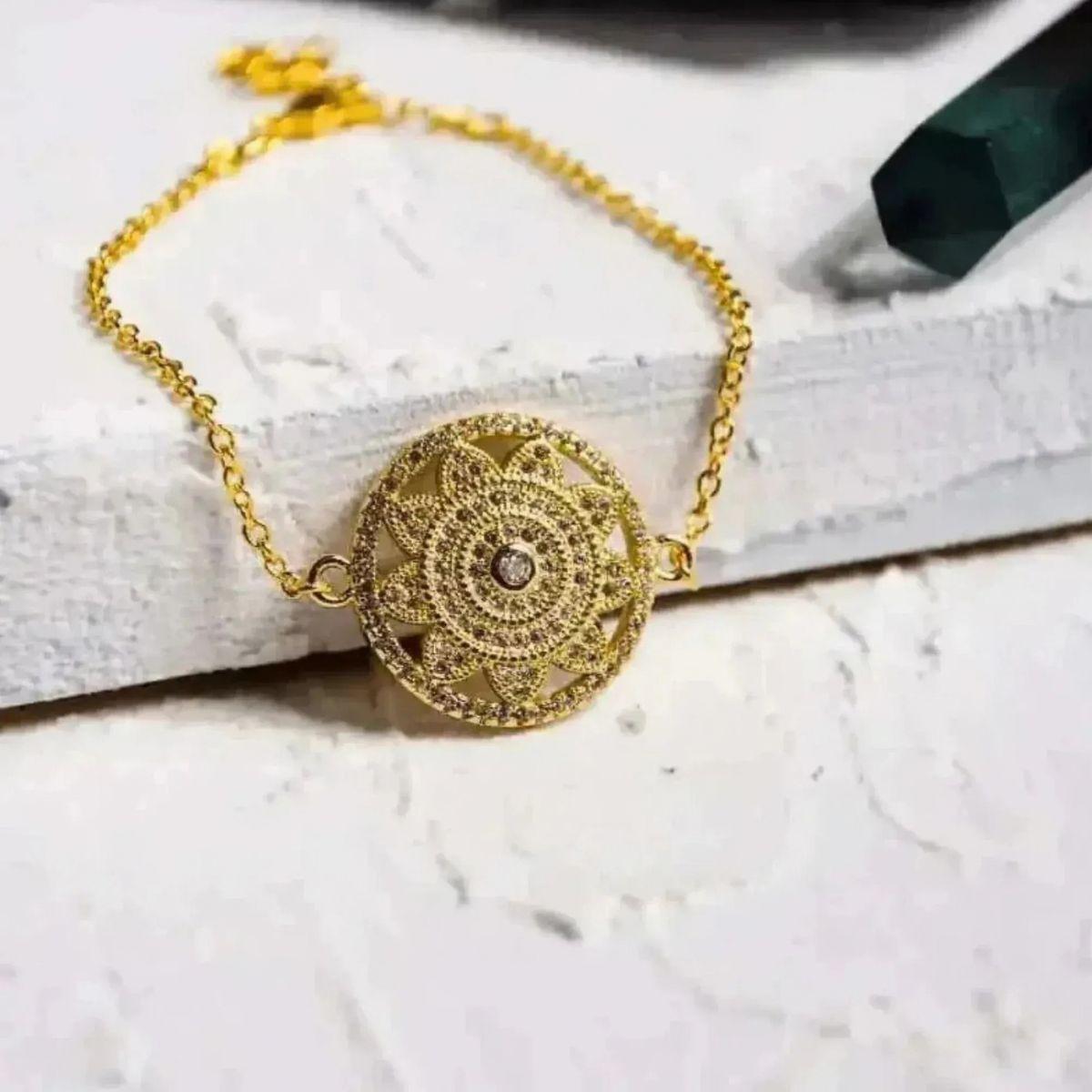
Mandala Meditation Bracelet | Brushed Gold or Silver
Start here if the circle is something you want to touch rather than look at. The brushed finish keeps it quiet: an everyday bracelet at a distance, a mandala up close, which is the right order of operations for a symbol you wear for yourself.
This is the piece for the woman in the middle of the sweeping right now: the last box out of the house, the last week of the job. Something to put a thumb on under the table. See the Mandala Meditation Bracelet.
Mandala Ring | Waterproof Stainless Steel
Waterproof stainless steel means this one stays on through dishes, the lake and the garden. If you're the kind of woman who takes jewellery off “so it doesn't get ruined” and finds it in a dish six months later, this solves that. A ring also sits where you can see it without looking for it, which is a different job from a pendant. See the Mandala Ring.
Mandala Necklace | Gold Plated Pendant
The pendant gives the geometry room to be read. It's gold plated and sits at the centre of the chest, which is either a coincidence or the most on-the-nose placement in the catalogue.
This is the gift piece of the three. It's what you send a sister who has just sold the family house, with a note that doesn't try to fix anything. See the Mandala Necklace.
All three are metal, so look after them accordingly: off before the pool, dry before the drawer, away from perfume and lotion. The jewellery cleaning guide in Keep Reading has the full routine.

A small practice, if you want one
Nothing precious, and no sand required.
Pick one circle you built that's over. Name it out loud, alone in the car if that's easier: what it was, how long it ran, who it held. Then say what it was for. Not what it produced. What it was for. “It was so they'd have somewhere to come back to.”
Then answer the only question that matters: is that thing still true?
Usually it is. The house is sold and they still have somewhere to come back to, because it turned out to be you. The job ended and the people you trained are still doing it right. That's the sand in the river.
Do it once. Don't make it a nightly ritual; this symbol says you're allowed to finish something.
The circle you're building now
The sand mandala gives you something a greeting card can't: permission to start another one.
If you already know that nothing gets kept, and that not keeping it isn't a waste, there's no reason to spend the next twenty years protecting yourself from an ending you've already survived.
Start the circle. Measure it properly. Put something worth centring at the middle of it. Then build it like it's going to last, knowing exactly what happens to sand.
Find the stone for this chapter
The Gemstone Quiz takes 60 seconds and asks what's going on in your life, not your favourite colour. And if the sweeping has left you unsure who you are in the next chapter, the Spirit Animal Quiz comes at it from the side door.
Keep Reading
- The sacred symbols guide: every symbol, side by side
- The Flower of Life meaning guide: the mandala's closest relative
- The prayer wheel guide: the same tradition, turning instead of sweeping
- The jewellery cleaning guide
Mandala Meaning FAQ
What does the mandala symbol mean?
A mandala is a circle organised around a centre, used for centuries across Hindu and Buddhist practice as a map of a whole world and a focus for meditation. The rings are the arrangement of things; the centre is what they're arranged around. Worn as jewellery, it's an intention for wholeness, and for staying centred while the outer rings change.
Why do Tibetan monks destroy sand mandalas?
The dismantling is part of the practice. The sand is swept up ceremonially and poured into moving water so that what was made disperses outward rather than staying in one room. It's a deliberate teaching about impermanence: something can be complete, and cared for entirely, without being permanent.
Is it disrespectful to wear a mandala if I'm not Buddhist or Hindu?
The circle isn't the exclusive property of any one tradition; versions of it appear independently across many cultures. What matters is knowing what you're wearing and why, rather than wearing it as decoration. If you can say what it means and where it comes from, you're wearing it with respect.
What's the difference between a mandala and the Flower of Life?
Both are sacred geometry built on the circle, and they're close cousins. The Flower of Life is one specific fixed pattern of overlapping circles; a mandala is a broader form, any concentric design organised around a centre, with countless valid versions. Start with whichever pattern your eye keeps returning to, or read the full Flower of Life guide.
How do I care for mandala jewellery?
These pieces are metal (gold plated, stainless steel and brushed metal), so the routine is short. Jewellery on after perfume, lotion and hairspray; off before pools and hot tubs; dry before it goes back in the drawer. Stainless steel is the most forgiving of the three.
Which mandala piece should I start with?
If you want something to touch during a hard week, start with the bracelet. If you want a piece that never comes off, the waterproof stainless steel ring is the one. If you want the geometry visible and readable, or you're buying for someone else, the gold plated pendant is the gift piece. All three are in the mandala collection.
Next up: 666, the only angel number people apologise for seeing.
Join The Circle and it lands in your inbox first, with 15% off your first order (good 7 days) and the Birthday Club.
Join The CircleMystic Soul Jewelry — Canadian small business, Calgary, Alberta, since 2008.
— Andrea


