

Four places most people start:
 Flower of Life Necklace$25
 Flower of Life Earrings$28
 Flower of Life Bracelet$25
 Flower of Life Ring$35
Shop Flower of Life jewelry Shop the gift guide
The short answer: the Flower of Life is nineteen overlapping circles in a hexagonal grid, and it stands for connection, the idea that nothing in the pattern stands alone. Cultures that never compared notes kept drawing it. The interesting part is why, and it's not the reason most sites give you.
Nineteen overlapping circles, drawn by cultures that never met, and one chapter of your life where it finally makes sense.
A woman picked up the Flower of Life necklace at a market table last fall, turned it over twice, and said: "I've seen this everywhere and I have no idea what it is."
Same. For years.
I knew it was on yoga studio walls and the back of every mala box in existence. I knew it looked good. I could not have told you what it meant, where it came from, or why it kept showing up on things I liked. And nobody selling it seemed inclined to explain, which is a small pet peeve of mine, because a symbol you can't explain is just a shape.
So here's the shape, explained. What it is, where it came from, what it's traditionally understood to mean, and why it lands differently once you've got a few decades of your own pattern behind you.
It's one of the symbols in the sacred symbols guide, if you want to see how it sits alongside the rest.

Jump to: What it is | Where it came from | What's hidden inside it | What it means | How to wear it | FAQ
What the Flower of Life Is
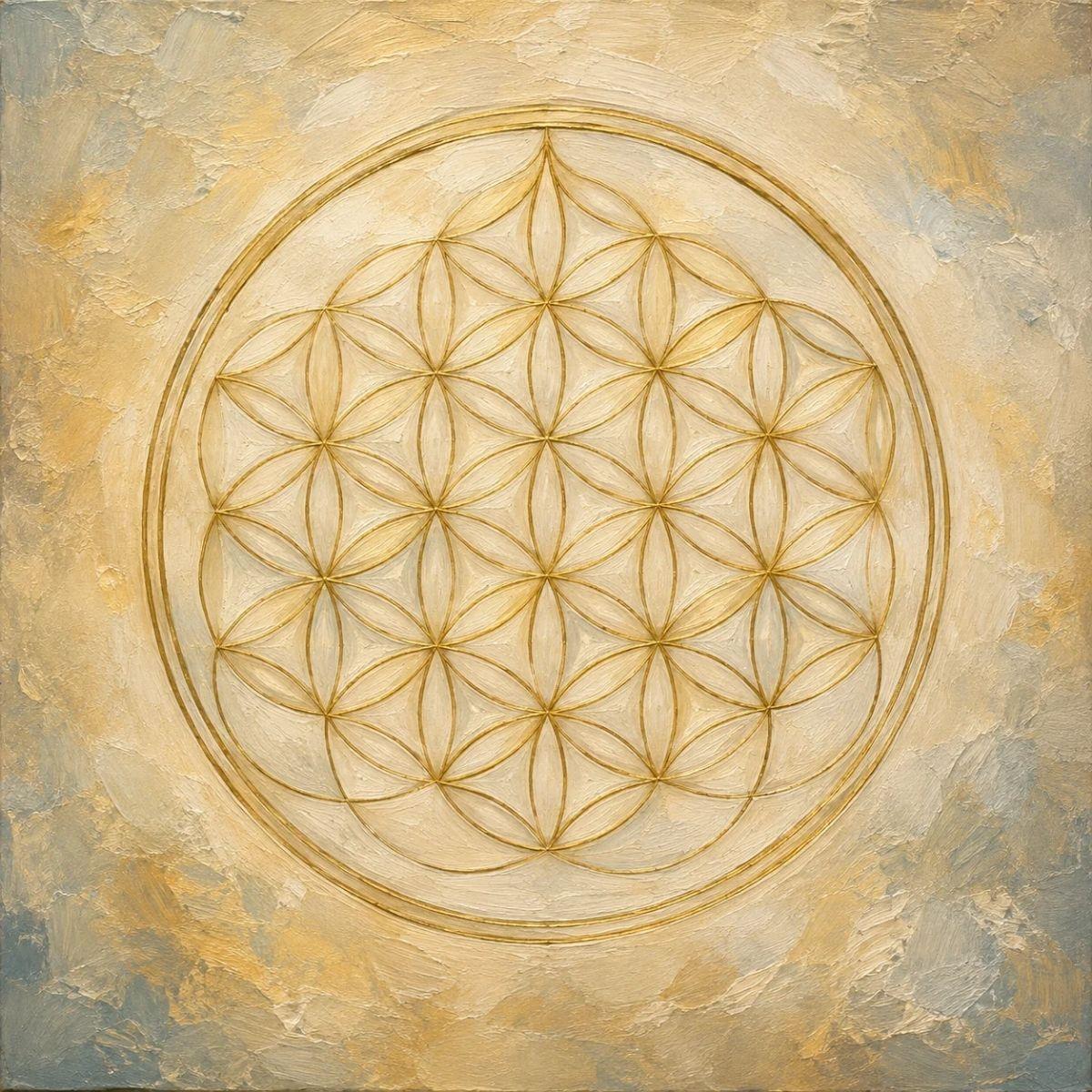
Nineteen complete circles, all the same size, each one overlapping its neighbours, arranged in a hexagonal grid and held inside two larger circles that ring the whole thing.
That's it. That's the entire design.
You can draw it with a compass. Circle, then six circles around it, each one centred on the edge of the last, and keep going. The pattern builds itself. You're not deciding where anything goes. The geometry decides. Every new circle lands exactly where the previous ones tell it to.
Which is a strange thing to sit with. Draw one and you'll feel it. You're not designing. You're following.
The petal shapes people see in it aren't drawn at all. They're what appears in the overlaps, the leftover spaces between circles. The flower is made entirely of the places where things intersect. I'd have led with that if I'd been the one naming it.

Where It Came From, and How Many Places It Turns Up
This is the part that changed how I felt about it.
The best-known early examples are drawn on the granite pillars of the Temple of Osiris at Abydos, in Egypt. You'll read online that they're six thousand years old. The temple is ancient, but the drawings on it are much harder to date, and researchers who've studied them place them far later than the building. Anyone who gives you a firm number is guessing with confidence.
What isn't contested is the spread. The same overlapping-circle pattern shows up:
- In the Forbidden City in Beijing, under the paw of a guardian lion
- Carved into temple walls in India and Japan
- In synagogue mosaics in Israel, and in Byzantine, Phoenician and Assyrian remains
- In Spanish and Italian churches
- In Leonardo da Vinci's notebooks, where he drew it repeatedly and worked out the proportions inside it
Continents apart. Centuries apart. Many of these places never traded a single idea. All arriving at the same circles.
There's a tidy mystical explanation for that and a very boring mathematical one, and the boring one is more interesting to me: this is the pattern you get when you pack circles as tightly as circles can be packed. Bees found it. Soap bubbles find it. Anyone with a compass and an afternoon finds it. It's less a message hidden in stone than a place every curious human eventually walks to.
People kept drawing it because it's what's there. That doesn't make it less remarkable. It makes it less lonely.
What's Hidden Inside It
The pattern nests. Pull out different pieces and you get symbols with their own names and their own long histories.
The Vesica Piscis: two overlapping circles, and the almond shape between them. The simplest unit in the whole design, and the one every other shape is built from. Traditionally read as the meeting point of two worlds. Two things overlap; something new exists in the overlap.
The Seed of Life: seven circles. One in the centre, six around it. Often connected to the seven days of creation, and worth knowing on its own if you want the simplest version of the symbol.
The Fruit of Life: thirteen circles pulled out of the larger grid. Connect their centres and you get Metatron's Cube, which holds the five Platonic solids: the shapes the Greeks assigned to earth, air, fire, water and the cosmos.
So: circles, inside circles, producing solids, standing for elements. All from one compass and a repeated instruction.
What the Flower of Life Means
Across traditions it lands on more or less the same idea: everything is connected, and the same pattern repeats at every scale.
Which sounds like something printed on a candle. So let me put it the way it arrives in real life.
The pattern isn't nineteen separate circles sitting near each other. Every circle passes through the centre of the ones beside it. Remove one and the shape doesn't lose a piece. It loses its structure. Nothing in it stands alone, and nothing in it is decoration.
Also worth knowing: a fertilised human egg divides into two cells, then four, then eight, and those early clusters look a lot like the overlapping circles of the Seed of Life. Whoever first drew this had no way of seeing that. They drew it anyway.
Three things people tend to carry it for:
Connection. The plainest reading. You are part of a pattern, not a loose thread in it.
Order underneath the mess. There is structure in this thing whether or not you can see the whole of it from where you're standing. Some weeks that's the only useful thought available.
Wholeness. Every circle is complete on its own and part of something larger. Both, at once, no contradiction. Anyone who has been somebody's mother and somebody's employee and somebody's daughter in the same afternoon already understands the geometry.
I'll say the thing I always say: a symbol doesn't do anything to you. It reminds you of something you already decided. The Flower of Life is a good reminder because it's quiet, it's old, and it doesn't announce itself across a room.
Note: Symbolic meanings come from spiritual and historical traditions. Wear what resonates as a personal reminder.

Why This One Lands Differently Later
At twenty-five, "everything is connected" is a nice sentiment you'd put on a wall.
At fifty-five you have receipts. You've watched the job that fell through turn out to be the reason you were free the week someone you love needed you. You've had the friendship that ended badly circle back nine years later as something better. You've seen enough of your own pattern to recognise you're standing in one.
That's the difference. Younger, it's a hope. Later, it's an observation. Same nineteen circles, completely different weight.
It's also, quietly, the least performative symbol I carry. No one stops you to ask about it. It reads as a pretty geometric pendant to anyone who doesn't know, and as thousands of years of people reaching the same conclusion to anyone who does. That gap is the whole appeal.
How to Wear It
All four live in the Flower of Life jewelry collection, and every one is waterproof stainless steel.
- Necklace. The one to start with. The Flower of Life Necklace sits mid-chest, which is where a reminder should sit: close enough to touch without thinking about it. Round pendant in two sizes, or a flower-edge version, gold or silver. It goes in the shower, in the lake, and through the dishwater without a conversation.
- Earrings. The Flower of Life Earrings come two ways: saddle hoops with the pattern cut clean through, or lighter drops on a shepherd's hook. Either way the light moves in them. For the days you want to look considered without looking effortful.
- Bracelet. The Flower of Life Bracelet is the one you'll see all day, which matters more than people expect. A pendant reminds you when you catch it in a mirror. A bracelet reminds you every time you reach for something.
- Ring. The Flower of Life Ring is the quietest of the four, visible only to you and whoever you're handing something to.

Stacking it: the Flower of Life is geometric and even, so it plays well with organic shapes rather than competing with them. Layer the pendant over a longer stone necklace, or wear the bracelet beside a gemstone stack. The layering guide covers lengths and spacing properly.
Keeping it right: stainless steel is forgiving, but not immortal. Wipe it after a swim, keep it out of a pile with everything else, and my notes on how to clean stainless steel jewelry handle the rest.
Stones That Pair With the Flower of Life
- Clear quartz + Flower of Life: clarity, and the plainest version of the pattern's message.
- Amethyst + Flower of Life: the reflective end of things.
- Labradorite + Flower of Life: for when you're mid-transition and can't see the whole shape yet.
The Flower of Life as a Gift
This is a good one for the person who is spiritual but allergic to being handed something obvious. It doesn't declare a belief system. It's a nice piece of geometry that happens to have thousands of years behind it, and you can decide how much of that to say in the card.
It also works for an occasion that doesn't have a symbol of its own: someone who has just come out the far side of something. A move, a diagnosis cleared, a marriage ended, a business closed. "Everything connects" is a difficult thing to say out loud to a grown woman without sounding like a poster. It's much easier to hand over.
You don't have to give the speech. Let the piece hold the meaning, and she'll go looking for the rest of it herself when she's ready. More ideas by meaning are in the gift guide.
Not sure which stone is for the chapter you're in?
The Gemstone Quiz takes 60 seconds.
Take the Gemstone Quiz →
Flower of Life FAQ
What does the Flower of Life symbol mean?
It represents interconnection and wholeness: the idea that everything is built from the same repeating pattern and nothing exists in isolation. The design is nineteen overlapping circles in a hexagonal grid, and because every circle passes through the centre of its neighbours, no part of it stands alone.
How old is the Flower of Life?
Nobody knows for certain. The best-known early examples are on the pillars of the Temple of Osiris at Abydos in Egypt, but the drawings are likely much younger than the temple, so the "six thousand years" figure you'll see online isn't reliable. What is certain is that the pattern turns up across Asia, the Middle East and Europe, and in Leonardo da Vinci's notebooks, where he studied its proportions.
What's the difference between the Seed of Life and the Flower of Life?
The Seed of Life is seven circles: one centre circle with six around it. The Flower of Life is the full nineteen-circle pattern that grows out of it. The Seed is the beginning; the Flower is the completed grid.
Is the Flower of Life a religious symbol?
It isn't tied to a single religion or lineage. It appears in Egyptian, Buddhist, Hindu, Jewish and Christian settings, which is part of why it's so widely worn. There's no rule about who may wear it and no ritual required before you do.
Is Flower of Life jewelry okay for everyday wear?
Yes. Every Flower of Life piece I carry is waterproof stainless steel, so it handles showers, swimming, hand-washing and daily wear. Wipe it dry after a swim and store it separately from other pieces.
Does the Flower of Life have healing powers?
No, and I won't tell you otherwise. It's a symbol, not a treatment. What it does is remind you of something you've already decided to believe, which, on the right day, is worth something.
Keep Reading
- The sacred symbols guide — every symbol, side by side
- Tree of Life Meaning
- Om Meaning: The Sound Everything Started With
Mystic Soul Jewelry — Canadian small business, Calgary, Alberta, since 2008.
Want the next symbol guide in your inbox when it goes up? The prayer wheel is next. Join The Circle. It's my list, it's free, and 15% off your first order and the Birthday Club come with it.
— Andrea


