

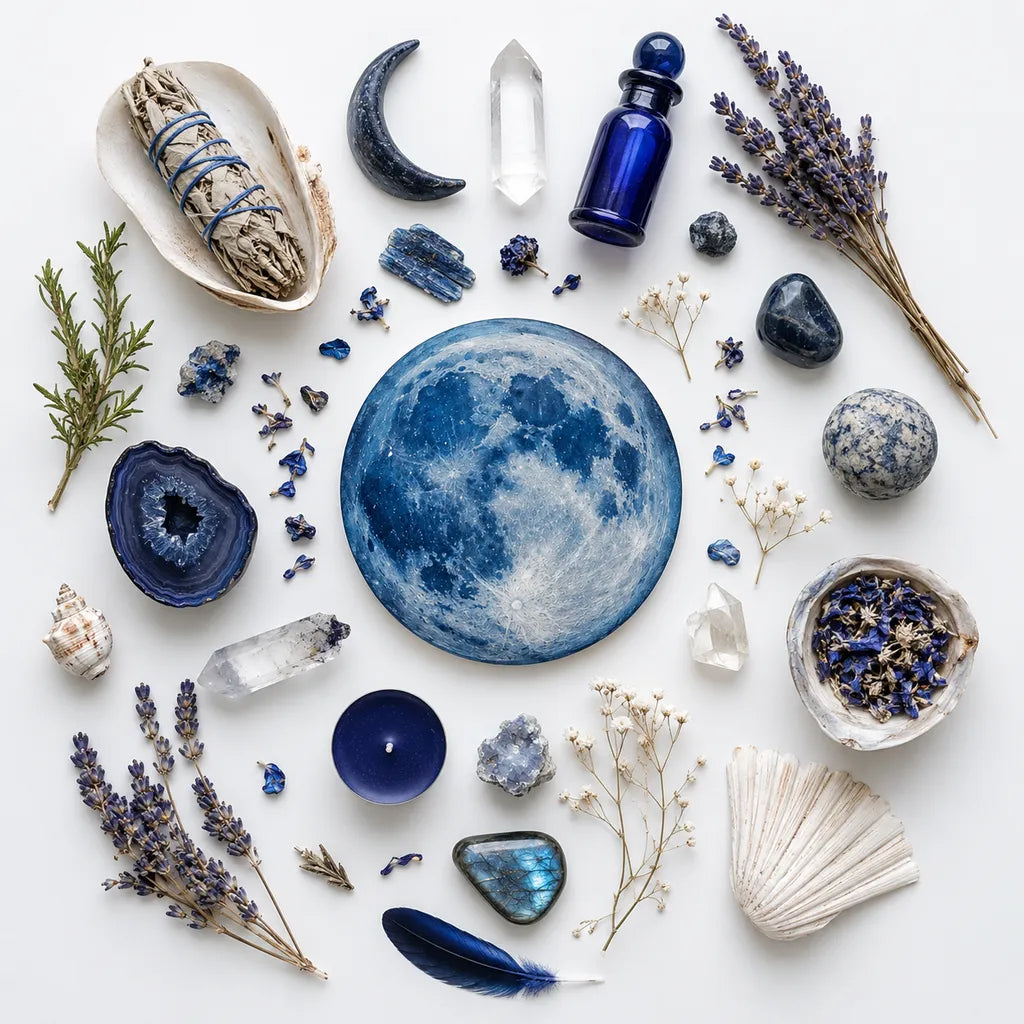
Moon Magic Guide · Blue Moon Meaning
Quick Shop: Celestial Jewelry · Gemstone Jewelry · Bracelet Stacks · Best Sellers
Every couple of years, the moon shows up twice in the same month. The astronomical name for this is a Blue Moon. The emotional name is extra credit.
If the first full moon of the month was for releasing what you'd been carrying, the second one is for everything you missed the first time. It's the addendum. The actually, there's more. The sky saying: here, another shot at it. Which is either beautiful or a lot, depending on the week you've had.
This is the meaning guide — what a Blue Moon is, where the name came from, what the old traditions say about it, and why the rare ones are worth marking. If you want the ritual itself, that lives in the non-intimidating Blue Moon ritual guide. This is the why.
Jump to:
- What a Blue Moon actually is
- Where the name comes from (it isn't the colour)
- Why it reads as "extra credit"
- The 2026 Blue Moon — and the next one
- What the old traditions say
- The stones that carry Blue Moon energy
- What to pay attention to
- Blue Moon FAQ
What a Blue Moon actually is
A Blue Moon is the second full moon that occurs in a single calendar month. That's the popular definition, and the one most people mean when they say the phrase.
There's also a rarer astronomical definition — the third full moon in a season that contains four — but you can file that away unless you're a professional astronomer. The calendar-month version is the one worth marking, and the one everyone's referring to when they post about a Blue Moon on Instagram.
How does it happen? A lunar cycle is about 29.5 days. A calendar month is 30 or 31 days. So every few years, the timing works out that two full moons fit inside the same month — one at the start, one at the end. It's not a mystical anomaly. It's arithmetic that feels mystical because it's rare.
Blue Moons happen roughly every two to three years, which is where the phrase "once in a blue moon" comes from. (If you've been using that expression without knowing why — welcome. Now you know.)

Where the name comes from (it isn't the colour)
The moon is not actually blue. Sorry. It is, and always has been, regular moon-coloured.
The name most likely comes from Old English — a folk corruption of the word belewe, meaning "betray." The second full moon of a month betrayed the usual once-a-month pattern by showing up an extra time. The name stuck. The connection to actual blue light was largely accidental.
There's one exception: on very rare occasions, atmospheric particulates from massive wildfires or volcanic eruptions have scattered red light in such a way that the moon genuinely looks blue-ish. This happened after the 1883 Krakatoa eruption, which gave us blue moons for close to two years. But it's an atmospheric phenomenon, not a lunar one. Generally, if your moon looks blue, check the air quality index.
So: not blue, actually rare, and named after a linguistic accident. Good things to know at dinner parties.
Why it reads as "extra credit"
Here's the framing that works for me.
A regular full moon is a checkpoint. Once a month, the sky shows up at its brightest and signals: this is the peak, notice what's built up, release what's done. It's a natural rhythm. You don't have to do anything with it, but if you do, it's reliable.
A Blue Moon is the same checkpoint a second time. The release you thought was complete? The sky is handing you another sheet of paper. The intention you half-set at the first full moon, the one you didn't fully mean? This is the do-over. Try again. Finish it properly this time.
That's why the "extra credit" language lands. It's the second chance that wasn't on the syllabus.
And because Blue Moons are rare, they tend to show up at moments in your life when a second chance would be useful. That might be confirmation bias. It also might not be. I don't pretend to know which. I just know the people I talk to who mark Blue Moons tend to remember them for a reason.
The 2026 Blue Moon — and the next one
The most recent calendar Blue Moon fell on Sunday, May 31, 2026 — the second full moon of that May, following the Flower Moon on May 1. It's a useful one to understand, because it shows how the pieces stack.
It was in Sagittarius. A full moon always sits in the sign opposite the sun, and with the sun in Gemini through June 20, the May 31 full moon fell in Sagittarius — the sign of expansion, honesty, truth-seeking and the long view. A Sagittarius full moon asks: what would I do if I stopped being small about this? What's the bigger truth I've been avoiding?
It closed a double-full-moon month. The Flower Moon on May 1 was in Scorpio — intense, depth-charging, focused on what's hidden. Four weeks later, the Blue Moon landed in Sagittarius, the exact opposite flavour. Whatever Scorpio pulled up, Sagittarius asked you to speak honestly about.
It was a calendar Blue Moon, not a seasonal one. The one before it was a seasonal Blue Moon in August 2024 — an astronomical curiosity but a quiet cultural moment. Before that, the popular version showed up in August 2023.
The next calendar Blue Moon arrives at the end of December 2028. Which is a long wait, and worth putting in a calendar now if you're the sort of person who likes to mark them.
If you want to see how the lunar cycles pair with what you're wearing, Moon Magic gathers every moon guide in one place.
What the old traditions say
Every culture that tracked the moon had a response to a second full moon. Some of what we know, briefly:
European folk tradition marked the Blue Moon as a time of heightened possibility — a moon for impossible tasks, for finally getting around to the thing you'd been putting off, for the love you hadn't been able to confess. "Once in a blue moon" historically meant: this rarely happens, but when it does, use it.
Celtic tradition treated extra full moons as sacred interruptions — signs that the usual rhythm was being rewritten for a reason. Work done on such a moon was said to hold more than the usual weight.
Christian farming calendars — specifically the Maine Farmers' Almanac where the seasonal definition originated — used the extra full moon to schedule religious observances and agricultural milestones. Pragmatic, not mystical, but the acknowledgment that the extra moon mattered is the common thread.
Modern astrology treats the Blue Moon as an amplified full moon — a reinforcement of the lunar work you began earlier in the month. Same energy, second helping.
Across traditions, the pattern holds: rare event, heightened significance, worth marking.
The stones that carry Blue Moon energy
If you're going to mark a Blue Moon with a piece of jewelry, these four stones carry lunar energy best.
Moonstone — the literal moon stone. Cycles, intuition, the cyclical nature of being alive. Also June's birthstone, if you're a June baby.
Labradorite — the transformation stone. Catches light from unexpected angles, which is the entire metaphor. One of my hero stones, stocked heavily. For a full deep-dive, see the Labradorite Crystal Guide (meaning, properties, jewelry).
Clear quartz — the amplifier. If you already have a piece you love and it isn't classically lunar, pair it with clear quartz.
Selenite — named for Selene, Greek goddess of the moon. The cleansing stone. Doesn't love water, so keep it dry — the moonlight, smoke and sound guide covers which stones can take water and which ones absolutely cannot.
Browse the full Celestial Jewelry collection (moon, star and sun crystal jewelry) for moon-forward pieces, or the full Gemstone Jewelry collection (shop by stone and meaning) to pick by stone.


Not sure which stone is yours for this one? The free personalized Mystic Soul Chakra Quiz takes two minutes. Useful when the sky's offering extra credit and you don't want to overthink the jewelry part.
What to pay attention to
You don't have to do a full ritual to mark a Blue Moon. You can just notice. Here's what's worth watching for in the days around one.
- What keeps coming up. The idea, person, situation, or feeling that won't leave you alone that week. Blue Moons tend to re-surface whatever got half-processed earlier in the month.
- What you're avoiding saying. If there's a true thing you've been sitting on, this is the week it wants out.
- What a second chance would look like. Literal question. If you were handed one do-over this month, what would you use it for? The answer is usually instructive.
- What you already know. Not what you're trying to figure out — what you already know and haven't acted on. A Blue Moon is a good moment to stop deliberating.
You can do this as little or as much as you like — even just noticing what comes up counts. If you'd rather have actual steps, the Blue Moon ritual guide is the low-commitment version, written for people who are curious but not sold.

And if moon content is your thing in general, the full library pairs well: New Moon Rituals for Beginners (intention setting with crystals) for the intention side, Leo Full Moon crystal ritual for a manifestation-heavy moon, and Blood Moon Rituals (total lunar eclipse guide) for the eclipse version.
— Andrea 🌙 / Mystic Soul Jewelry
Want the moon guide before the moon rises? Free moon phase rituals and crystal pairings — my voice, no fluff, no fake urgency. The stone I'm wearing, what's coming in the sky, and the ritual guide before it goes live. Get the moon guides here. Already in the Circle? You get them earlier still.
Blue Moon FAQ
When was the Blue Moon in 2026?
The Blue Moon of 2026 fell on Sunday, May 31, 2026 — the second full moon of May, following the Flower Moon on May 1. The moon was in Sagittarius at the moment of the full moon.
When is the next Blue Moon?
The next calendar Blue Moon arrives at the end of December 2028. Calendar Blue Moons typically happen every two to three years, so it's a genuine wait. If you'd rather not track it yourself, the moon guides are the low-effort way — I'll send a note before each one.
When was the last Blue Moon before 2026?
The last popular (calendar-month) Blue Moon before 2026 was on August 30–31, 2023 — a rare Super Blue Moon. In between, there was a seasonal Blue Moon on August 19, 2024, which uses the older astronomical definition (the third full moon in a season of four). Calendar Blue Moons tend to be what people recognize.
What does a Blue Moon mean spiritually?
Across traditions, a Blue Moon is understood as a second chance or amplified full moon — reinforcement of whatever lunar work began earlier in the month. European folk tradition associates it with impossible tasks finally becoming possible; modern astrology treats it as a heightened full moon carrying extra weight. Practically, it's a rare checkpoint — useful for finishing what you started.
Why is it called a Blue Moon if it isn't blue?
The name likely comes from the Old English word belewe, meaning "betray" — the moon betrayed the usual once-a-month pattern by showing up twice. The colour association came later and is mostly a linguistic coincidence. Rare atmospheric events (major volcanic eruptions, massive wildfires) can occasionally give the moon a genuinely blue tint, but that's unrelated to the naming.
How often does a Blue Moon happen?
Calendar Blue Moons happen roughly every two to three years, which is the origin of the phrase "once in a blue moon." Seasonal Blue Moons (the older astronomical definition) happen on a similar frequency. Both are rare enough to be culturally significant but common enough to appear within most decades.
What sign was the 2026 Blue Moon in?
The 2026 Blue Moon was in Sagittarius. Full moons always sit in the sign opposite the sun, and with the sun in Gemini through June 20, the May 31 full moon landed in Sagittarius. Sagittarius full moons are associated with expansion, truth-telling, big-picture thinking, and the courage to say the honest thing.
What should I do during a Blue Moon?
You don't have to do anything. But if you want to mark it, the simplest practice is to pause — at a window, for ten minutes — and notice what keeps coming up that week. Writing one sentence about what you're putting down and one sentence about what you want the next six months to feel like is the compact version. The full ritual guide walks it through properly.
Keep exploring: Celestial Jewelry · Gemstone Jewelry · Bracelet Stacks · Blue Moon Ritual Guide · Moon Magic Jewelry guide · New Moon Rituals for Beginners
Canadian-designed. Worn under every moon.


