

Quick Shop: Spiritual Symbols · Crystal Necklaces · Gemstone Jewelry · Best Sellers
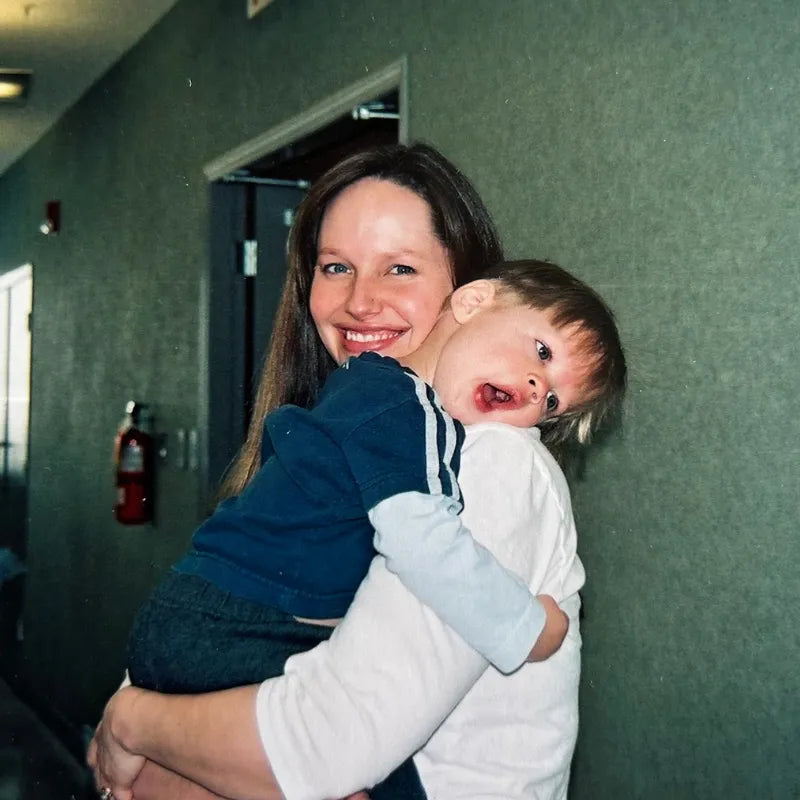
The year Harper was born, I had a jewelry drawer full of options and wore exactly two things.
One was my wedding ring set — a combined wave design, gold encasing the diamond on either side, two bands that felt like movement and water and light when they caught the sun. The other was an Om pendant on a thin chain, resting just below my collarbone. That was it. I had been collecting jewelry for years. I had drawers full. And for that entire first year of motherhood, my hand reached for the same two pieces every single morning.
I didn't think about it at the time. I was too busy trying to figure out how to be a stay-at-home mom. It's only years later, now that I make jewelry for a living and have spent time studying what calming the nervous system actually means, that I understand what I was doing. My body knew before my mind did. It was reaching for regulation.
This is the story of that year. And what I'd tell you now if you're in it.
Jump to:
- Before Harper: the jewelry drawer, the design dreams, the travel
- The deal, the name, and nine months of waiting
- The first year of motherhood, honestly
- What I actually wore
- The Om collection, from Bali to Hawaii
- What I know now about why this worked
- What I'd tell a new mother now
- FAQ
Before Harper: the jewelry drawer, the design dreams, the travel
Before Harper, I was young, bright-eyed, full of design dreams. I hadn't started Mystic Soul yet — that would come much later, after years of wearing meaningful jewelry before I ever made it.
Two things were true about me. The first was that I loved jewelry. Not as accessories — as objects. I collected pieces the way other people collect books or records or small ceramic things from their travels. A ring from Mexico. A pendant from a market in Bali. Something unnecessary but personal from every place I'd been.
The second was that I was a sociology student with a quiet fascination for rituals of adornment. Every culture I studied had one. The bracelet a new mother received. The pendant worn through grief. The ring marking a promise. Jewelry wasn't decoration — it was how humans made a moment wearable. I couldn't read those texts without wanting one of every piece described.
By the time I got pregnant with Harper, my drawer held more jewelry than most people own in a lifetime. Travel souvenirs. Design-student experiments. Gifts. Pieces I'd made myself before I ever called myself a maker. I loved all of it. I thought I always would.

The deal, the name, and nine months of waiting
Harper was named before he was born.
The name was the product of a small domestic negotiation. I agreed to change my last name — and in exchange, I got to name our first-born, boy or girl. The name I chose was Harper, after my grandparents. It had been in my back pocket since I was about twenty. The first time I said it out loud as a possibility, it felt less like a decision and more like a recognition.
I spent nine months making his bedding. All of the decor for his nursery. Every small thing I could touch with my hands before he arrived, I wanted to have touched. I had the design dreams. This was the first project I got to see all the way through.
I didn't know then that making a nursery was only the gentlest possible rehearsal for what was coming. But my hands were learning something in those months that would matter later — that when your mind can't quite steady, there is something about making, about holding a material thing with intention, that keeps you here.
The first year of motherhood, honestly
The first year of motherhood was the most firsts of any year I've lived. First time I held him. First time he smiled. First time I watched him figure out his own hands. First time I wondered if I was doing any of it right. First time I understood why my own mother had been tired in the way she was tired.
It was also amazing and hard, often in the same hour. The amazing parts were the parts everyone tells you about — the smell of his head, the weight of him asleep on your chest, the absurd new love that arrives and just stays. The hard parts were quieter. The loneliness of being home alone with someone who couldn't yet speak. The way my identity had quietly reshuffled while I wasn't paying attention. The feeling of having become unrecognizable to myself while everyone kept telling me how lucky I was.
I don't say any of this to be dark. That year was real. The hard parts don't cancel the amazing ones. They just sit next to each other, which is the part nobody warned me about.
What I do remember with absolute clarity is this: I got dressed every morning. And every morning, my hand reached for the same two pieces of jewelry. Without thinking. Without choosing. Without even noticing.

What I actually wore
My wedding rings and my Om pendant. That was it. For a full year. From a drawer that held dozens of other options.
The wedding rings
My rings were a combined wave design — two bands that met in a soft undulation, gold flowing around the diamond on both sides. They felt like the ocean. They caught the light in small sparks when I turned my hand. I wore them proudly for twenty years before anything about my life meant I'd eventually set them down.
What I understand now is that I wasn't wearing them for the wedding they marked. I was wearing them for the feeling of them — the weight on my finger, the way I could rotate them absent-mindedly during a hard hour, the sparkle that caught my eye when everything else in my field of view was about somebody else's needs. They were mine. I looked at them and remembered, briefly, who I also was.
The strong necklace, before the Om
Here's what I see now, looking back at photos from those years:
It wasn't actually wedding rings plus Om for my whole adult life. It was wedding rings plus one strong necklace. Always one. Never a layered stack, never a delicate chain. Something with weight and presence and a story I'd hauled home from somewhere. The Om was just the version that stuck.
Before the Om, there were the masks.
For a long stretch of my early travel years, I was pulled — every single time — toward tribal designs and protective symbols. I had a mask pendant that was the favorite. A carved face, half human, half something else, heavy enough that I could feel it on my chest all day. I wore it everywhere. It became a signature piece before I knew I had a signature.
(Side road I can't resist: years later, I submitted a similar mask design to the wardrobe team for the show Bones. They put it on Emily Deschanel. I sat on my couch one evening and saw a version of my favorite necklace on screen, around the neck of the lead actress, which is the kind of full-circle moment you do not expect when you start hauling strange things home from markets in your twenties. You can find that kind of work — the pieces that have made it onto screen and into editorial — in As Seen On TV / Magazine. Anyway.)
What pulled me toward masks and tribal symbols — every time, no exceptions — was a feeling of protection. I couldn't have articulated it then. The sociology student in me probably could have. Masks across cultures are protective objects. Talismans you wear when you need to face something from behind something that holds you. I wasn't choosing them because I knew that consciously. I was choosing them because my body kept reaching.

And then, slowly, the masks gave way to the Om.
I don't remember the exact crossover. I remember the feeling — that I wanted something quieter. The masks were bold and outward-facing. The Om was inward. One sound, one symbol, the whole universe folded into something small enough to disappear into a collar. By the time Harper was born, the masks had been retired to the drawer for years already, and the Om was the one I never took off.
The pattern was the same, though. One strong necklace, doing the work of protection. The shape of the protection just shifted with the season I was in.
The Om pendant
The Om sat just below my collarbone. I'd been wearing it for years already by the time Harper was born — it was my go-to, the piece that had become so much a part of me that taking it off felt like taking off a piece of my hand.
People would ask. Why do you always wear an Om?
I was never one to give the full spiritual download to someone who hadn't really asked. My answer was usually some version of I love it or it's important to me. If they knew what the symbol was, they knew. If they didn't, I didn't need them to. No judgment either way. The symbol wasn't for explaining — it was for carrying.
Later, MSJ would become a brand with a whole Spiritual Symbols collection. That seed started here, with one pendant worn so long it wore smooth.
The Om collection, from Bali to Hawaii
Once I knew the symbol, I collected it.
Every time I travelled, I'd come home with another Om. A small pendant from Mexico, made out of a coin, hammered thin. A large brass medallion from Bali, heavier than I expected, worn on a cord. A delicate pendant from a market in Hawaii. Each one a little different. Each one a version of the same symbol, translated through a different hand.
The sociology student in me loved that. The same mark, carried across oceans, meaning the same underlying thing even as the craft of it shifted with place. I'd be in a market in a country I didn't know well, and I'd see the symbol, and I'd recognize it the way you recognize a friend across a crowded room. Something about that recognition felt grounding, especially the year I wasn't sure I recognized myself.
The Om is a sacred sound from Hindu, Buddhist, and Jain traditions — the vibration understood as the beginning of the universe. I learned what I could, and I wore the symbol with care for what it meant to the cultures it came from. I wasn't performing it. I was carrying it, in the way a person carries a touchstone.
If you're drawn to sacred symbols too, the Sacred Symbols guide walks through several, and the Tree of Life and Hamsa pieces cover two that often sit close to Om in the same tradition of near-the-heart talismans.
Not sure which symbol or stone is calling you right now? The free Gemstone Quiz takes two minutes. Useful in seasons when you can't quite tell what you need — which, if you're a new mother reading this, is probably right now.
What I know now about why this worked
At the time, I thought I was just a woman with strong preferences and a tired brain. I didn't have the language for what I was doing.
What I know now, after twenty years of yoga and studying a dozen different somatic and wellness modalities, is that the practice I leaned on the hardest during Harper's first year — my yoga mat — turns out to be a combination of somatic work, EMDR-adjacent bilateral movement, vagus nerve stimulation, and breath-based calming. My body had found a nervous-system regulation practice before I had words for one.
The Om pendant was part of that practice. Wearing it meant the practice followed me off the mat. Touching it mid-day — during a cry I couldn't soothe, during a moment I couldn't locate myself — was a two-second bilateral return to the same regulated state the yoga produced. A somatic cue. A tactile anchor. The science caught up to what my body had already figured out.
The wedding rings did something similar. Rotating them on my finger was a repetitive small motion — and repetitive small motions, we now know, are exactly how the nervous system down-regulates. Fidgeting a ring is vagus nerve work. I wasn't being absent-minded. I was keeping myself here.
This is why so many grandmothers wore the same three pieces every day of their lives. The body knows. It reaches for what holds it.
What I'd tell a new mother now
If you're in the first year and you've forgotten what you even like — if you open a drawer of things that used to be yours and nothing in it feels like yours anymore — you're not broken. You're regulating.
Here's what I'd tell you.
Gravitate to what your hand reaches for. Don't overthink it. The piece you keep putting on is the piece that's doing something for you. Trust it.
One or two pieces is enough. You don't need to rotate a whole collection right now. You need one or two anchors that make your nervous system exhale. Everything else can wait in the drawer.
Pick something you can wear through water, sleep, and a crying hour. If a piece requires being taken off and put back on, you're going to stop wearing it. Choose daily-wear materials — sterling silver, solid gold, good-quality plating, beaded bracelets that survive a shower if they have to. The jewelry care guide covers which materials actually hold up to being worn every single day, which matters more than usual in a year when you will not be taking anything off.
The meaning can be yours alone. You don't owe an explanation to anyone asking what the symbol means or why it matters. "It's important to me" is a complete sentence. The piece is for your regulation, not their curiosity.
It won't always be this tight a rotation. The year I wore only my rings and my Om was followed by a year where I added one more piece, then another. The drawer came back. But not until I was ready. There's no rush.
The jewelry I make now at MSJ — the Spiritual Symbols, the Chakra pieces, the beaded bracelets — is shaped by that year. I make meaningful jewelry you can actually live in because I remember exactly what it felt like to need that. If you're in that season now, I see you.
Come sit at my kitchen table.
The Circle is my list — 15% off your first order, and a crystal reading from me on your birthday. Step inside The Circle →
FAQ
What does the Om symbol mean?
Om is a sacred sound from Hindu, Buddhist, and Jain traditions — understood as the vibration at the beginning of the universe. The symbol you see on jewelry is the visual form of that sound. Worn close to the body, it functions as a touchstone for presence, breath, and grounding.
What crystals or symbols are good for new mothers?
The honest answer is: whatever your hand reaches for. That said, the stones new mothers tend to gravitate to are rose quartz (softness, self-compassion), moonstone (cycles, the body's own intelligence), and labradorite (the daily transformation of who you're becoming). For symbols, anything you can touch without thinking — Om, Tree of Life, a heart pendant. The piece that becomes part of your hand during a hard hour is the right one.
Why does wearing the same jewelry every day help?
Because the body uses repetitive small motion and tactile anchors to regulate the nervous system. Rotating a ring, touching a pendant, feeling the weight of a piece against your skin — these are somatic cues that signal safety. Grandmothers who wore the same three pieces for fifty years weren't being unimaginative. They were keeping themselves here.
Is it respectful to wear an Om symbol if I'm not Hindu or Buddhist?
I'm not the authority on this — and the thoughtful answer involves learning what the symbol means in the cultures it comes from, wearing it with care, and not treating it as decoration. For me, after years of yoga and study, the Om has become a daily presence I carry with respect for its origins. Your relationship with a sacred symbol is yours to navigate honestly.
What's the difference between meaningful jewelry and decorative jewelry?
Decorative jewelry finishes an outfit. Meaningful jewelry finishes a sentence — yours, about who you are right now, what you're carrying, what you're trying to remember. Both are valid. But the piece you keep reaching for during a hard year is almost never the decorative one.
What do you wear now, years later?
More now than I did then. A few stacked bracelets that change with the season. A pendant or two layered short and long. Earrings that survive the day. But there are still mornings — the harder ones — when I reach for one strong necklace, just like I did the year Harper was born. The pattern doesn't really leave you. It just gets gentler.
Keep exploring: Spiritual Symbols · Crystal Necklaces · Chakra Collection · Sacred Symbols Guide · Build a Meaningful Bracelet Stack
Handmade in Calgary. Worn through seasons that don't have words yet.


