

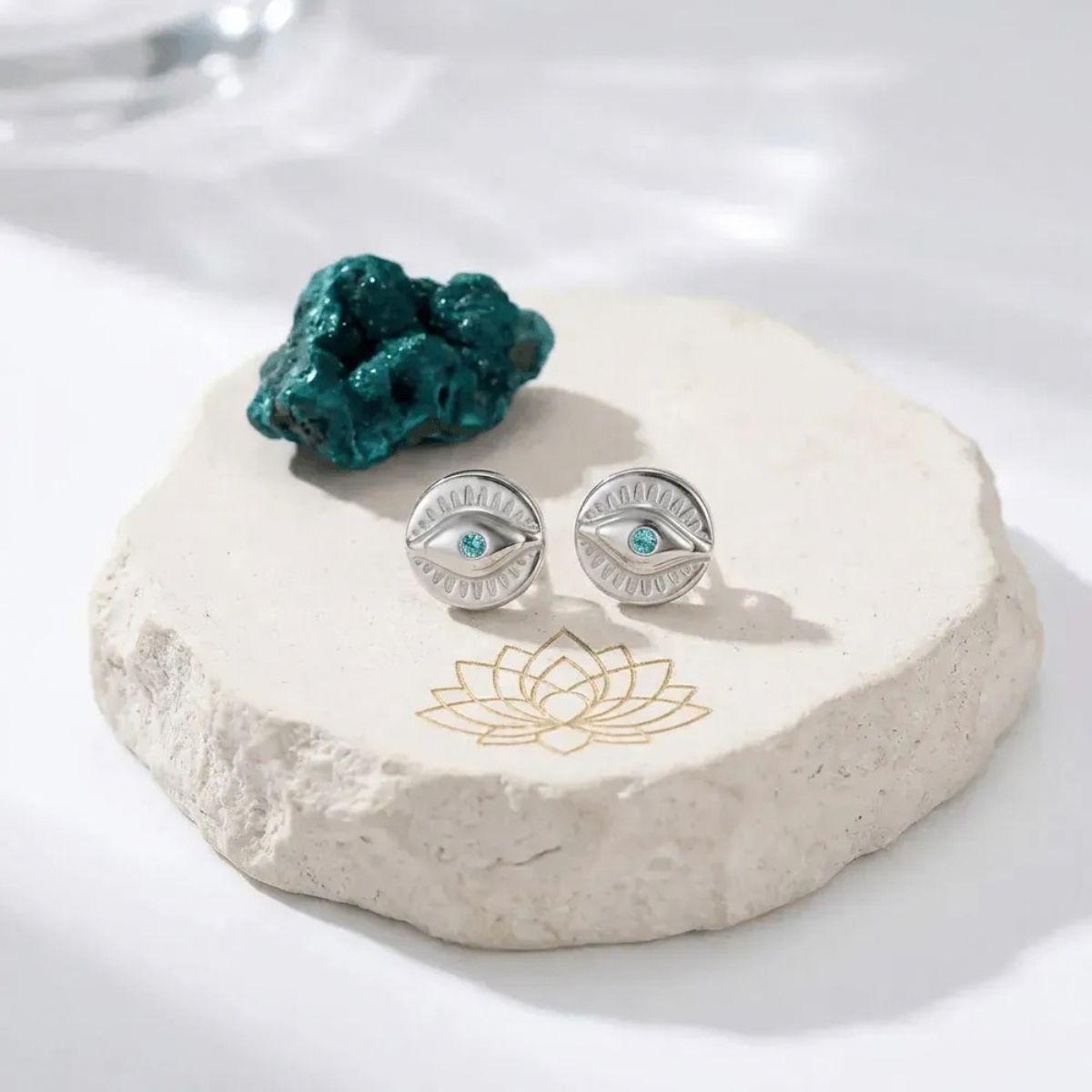
The Third Eye doesn't announce itself. It doesn't arrive with a vision quest or a dramatic moment of clarity. Most people who describe it say the same thing: they just started to know things. Quiet gut feelings that turned out to be right. Less spiralling in decisions that used to paralyse them. A sense that the fog had lifted from somewhere behind their forehead, and they could finally see what had been there the whole time.
That's Ajna. And it's more accessible than most people think.
Quick Shop: Third Eye Chakra Jewelry | All 7 Chakras | Third Eye Symbol Jewelry | Gemstone Jewelry | Crystal Necklaces
Looking for the symbol rather than the chakra? Third Eye Jewelry: For the Ones Who See Before They Look covers the symbol and how to wear it. This guide is the chakra practice underneath it. Both sit inside the Sacred Symbols guide.
A note on what follows: this post shares spiritual traditions and self-reflection practices. If you're experiencing persistent headaches, anxiety, or sleep disruption, speak with a qualified professional.
What is the Third Eye Chakra (Ajna)?
The Third Eye Chakra — called Ajna in Sanskrit — is the sixth energy centre in the chakra system, located between the eyebrows. It's associated with intuition, inner vision, and clear perception. The ability to see beyond what's immediately visible and trust what you know without being able to fully explain why.
Ajna translates most closely to "command" or "perception." A quiet reminder that your inner guidance isn't random static. It becomes clearer the more you practice listening to it.
When Ajna is balanced, there's less overthinking and more of that calm, grounded I know what's true for me quality. It's not psychic fireworks. It's clarity.
New to chakra work overall? Start with the beginner chakra guide, browse chakra jewelry across all seven centres, or find your own centre with the two-minute Chakra Quiz.
The sacred significance across traditions
What's striking about the Third Eye symbol is how consistently it appears across traditions that developed independently of each other. That kind of cross-cultural convergence usually means something essential is being named.

- Buddhist thought — the Third Eye represents awakening. The expanded awareness that comes when you stop seeing the world only through the lens of the conditioned mind.
- Hindu tradition — Ajna is the seat of inner perception and spiritual intelligence, often depicted as a lotus with two petals representing the sun and the moon. The balance of opposites into clear sight.
- Taoist philosophy — the equivalent concept centres on intuition, harmony, and alignment with universal flow. The ability to sense the right path before you can articulate why it's right.
Across all of them, the theme is consistent: there is a kind of seeing that happens beyond the physical eyes, and it can be cultivated.
What Ajna governs
- Intuitive wisdom — recognizing what's aligned and what isn't before you have "proof."
- Clarity — cutting through mental noise to see the bigger picture.
- Spiritual connection — the felt sense that your life has meaning and you're moving in a direction that matters.
- Self-trust — the ability to act on your inner guidance even when it can't be fully justified on paper.
Signs your Third Eye is opening
Most Third Eye activation doesn't look like Hollywood psychic vision. It looks like this:
- Your intuition becomes louder and more reliable. Gut feelings that turn out to be right. A stronger ability to read a room or a situation quickly.
- More vivid dreaming. Symbolic dreams, clearer recall in the morning, a sense that your dream life is communicating something.
- Clear knowing. Sudden insight that arrives whole, without a logical chain leading to it.
- Energy sensitivity. You know when something feels off even when everything looks fine. You read rooms before they're explained.
- Easier stillness. In meditation or even a quiet moment, the mental noise settles faster than it used to.
The key word is subtle. These shifts tend to accumulate rather than arrive all at once. You look back three months later and realize you've changed.
Crystals for Third Eye awakening
Crystals are intention anchors — tools for focus, ritual, and the kind of consistent practice that actually moves the needle. If you're working with Ajna, these are the ones I reach for.
The four I always come back to
Amethyst — the classic. It carries spiritual clarity energy. Calm, gentle, and unusually effective for quieting the mental chatter that drowns out intuition. My first recommendation for anyone starting Third Eye work. Read the amethyst meaning guide for the full picture.
Labradorite — the more complex one. Associated with inner knowing and transformation, with a quality I can only describe as the stone for when you already know the answer but need help trusting it. One of my hero stones — I keep it in heavy rotation. Read the labradorite guide.
Lapis lazuli — brings truth and wisdom. Worn by spiritual seekers and royalty alike for thousands of years (Cleopatra had it ground into eyeshadow, which is a flex). It has a gravitas that shows up in how it feels to wear it.
Clear quartz — amplifies whatever intention you're working with, which makes it an excellent pairing stone rather than a standalone.


Natural Stone Chakra Necklace — lapis lazuli, $35 · Clear Quartz Crown Chakra Bracelet — $28
Supporting stones
- Moonstone — for intuitive reception and dreamwork
- Fluorite — for focus and mental organization when Ajna feels scattered
- Sodalite — for the balance between logic and intuition
👉 Amethyst came up as your stone? Here's why amethyst →
👉 Shop the full Third Eye Chakra jewelry collection.
Daily practices for sustained clarity
Third Eye work is most effective when it's gentle and repeatable. The goal isn't a peak experience — it's a steady, grounded clarity that builds over time.
The morning anchor (3 minutes)
Hold amethyst at your brow for three slow breaths. Set one intention for the day — one sentence, one direction. This cues your nervous system toward receptivity before the day fills up with noise.
The midday reset (2 minutes)
If you feel yourself getting scattered or reactive, step away from your screen, put your palms over your eyes, and breathe slowly for two minutes. No phone. No input. Just a reset.
The evening record
Write down one intuitive nudge you noticed today and whether you followed it. Over weeks you'll start to see patterns — your guidance usually whispers before it shouts, and noticing it consistently is how you learn to trust it.
Wear the reminder
This is underrated. A piece of jewelry that holds your intention works as a passive cue throughout the day. Every time you catch it, you remember what you're practising. It doesn't have to be elaborate. It just has to mean something to you. That's the whole idea behind what I put in the shop.
The Third Eye and the Evil Eye — two eyes, one practice

The Third Eye opens inward. It's the clarity you cultivate within yourself, the intuition you practice trusting, the inner vision that helps you navigate your own life.
The Evil Eye faces outward. It's the ancient protection symbol worn to guard you from the energy that comes from outside yourself. Envy, ill will, the low-grade weight of other people's projections.
They complement each other in a way that feels almost too logical. Inner clarity is more accessible when your outer field is protected. And when your Third Eye is open, you're better at recognizing when your energy is being pulled and returning to yourself more quickly.
If you're drawn to protection alongside intuition, read the Evil Eye meaning guide.
Third Eye Chakra FAQ
What are the signs my Third Eye is opening?
The most common signs are a stronger and more reliable gut sense, more vivid or symbolic dreams, sudden clear knowing (insight without a logical chain), heightened sensitivity to the energy in spaces and people, and easier stillness during meditation. These tend to accumulate over weeks and months rather than arriving all at once.
What's the best crystal for Third Eye activation?
Amethyst is the most accessible starting point — it calms mental chatter so intuition can be heard. Labradorite is the deeper choice for trusting what you already sense. Lapis lazuli brings truth and gravitas. Clear quartz amplifies whichever stone you pair it with. Most people start with amethyst and add others as their practice deepens.
How do I know if my Third Eye is blocked?
Common signs of a blocked or imbalanced Ajna include persistent overthinking, indecision that loops, disconnection from your own gut feelings, difficulty visualizing or dreaming, mental fog, and a sense of being stuck in your head without access to deeper knowing. Gentle daily practice — breath, journaling, intention-setting with a crystal anchor — is the most reliable way to bring it back into balance.
Is the Third Eye the same as the Evil Eye?
No. The Third Eye is an inner chakra associated with intuition and inner vision — it opens inward, and you recognize the symbol by the rays radiating outward from it. The Evil Eye is an ancient outward-facing protection symbol, recognizable by its concentric blue circles, worn to deflect negative or envious energy from others. They complement each other beautifully: inner clarity is easier when your outer field is protected, and a clear Third Eye helps you recognize when your energy is being pulled.
Does Third Eye work connect to other chakras?
Yes. The Third Eye is most often paired with the Crown Chakra (Sahasrara) above it for spiritual connection, and with the Throat Chakra (Vishuddha) below it for expressing the truth you receive. A full Third Eye stack typically combines amethyst with clear quartz (Crown) and lapis lazuli or sodalite (Throat) for an integrated upper-chakra practice. See how all seven work together in the full chakra jewelry collection.
Can I wear Third Eye crystal jewelry every day?
Yes, and this is the practice I most recommend. Daily-wear amethyst, labradorite, or lapis lazuli pieces work as a passive intention cue — every time you notice them, you're reminded of what you're cultivating. Cleanse with moonlight or by holding under cool running water occasionally. Skip lotions, perfumes, and chlorine on the metal. Full instructions in the crystal care guide.
How long does it take to open the Third Eye?
There's no fixed timeline — but most people who practice consistently notice shifts within 6 to 12 weeks. The signs are subtle: more accurate gut feelings, less mental noise, easier decision-making. The work is gentle and repeatable, not dramatic. If you're looking for a peak experience, you'll miss what's actually happening.
How to wear it
The Third Eye doesn't require perfection. It requires practice — small, consistent, gentle practice. A crystal on your desk. A piece of jewelry that catches the light. Three breaths before you answer an email you're dreading.
👉 Explore Third Eye Chakra jewelry designed as wearable intention, browse Third Eye symbol jewelry for pieces that pair inner vision with Evil Eye protection, or start from the top with chakra jewelry for all seven centres.
Affirmations for Third Eye clarity
Pick one for a full week. Repetition is what trains self-trust — not variety.
"I trust my intuition and inner wisdom."
"I am open to clarity and aligned guidance."
"I see clearly and choose what supports my peace."
"My inner vision is steady, calm, and true."
Trust the whisper before it has to shout.
Keep Reading:


